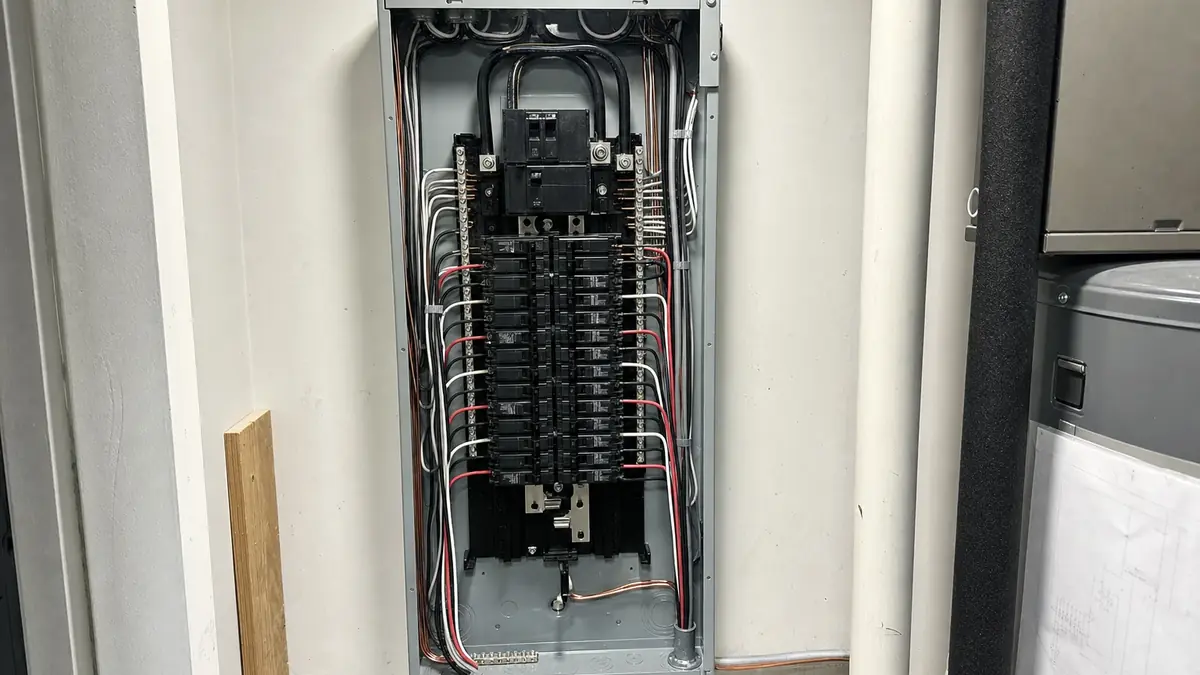
Whether a heat pump conversion needs a 200-amp service is decided by an NEC Article 220 dwelling load calculation, not a rule of thumb. Electric strip heat is what usually breaks the budget: a 10 kW bank draws about 42 amps and a 20 kW bank about 83. Dual-fuel avoids strip heat entirely and often avoids the upgrade.
What the calculation actually is
This is not a judgement call and not a rule of thumb. The National Electrical Code sets out a defined method in Article 220 for calculating the service load of a dwelling, including a standard method and an optional method for existing dwellings that permits demand factors based on the fact that not everything runs at once.
The calculation totals general lighting and receptacle load, small appliance and laundry circuits, fixed appliances, and then the larger of heating or air conditioning — since those do not operate simultaneously — and applies the code's demand factors.
The output is a number in amperes. If that number exceeds your service rating, the service must be upgraded before the heat pump is energised. There is no interpretation available.
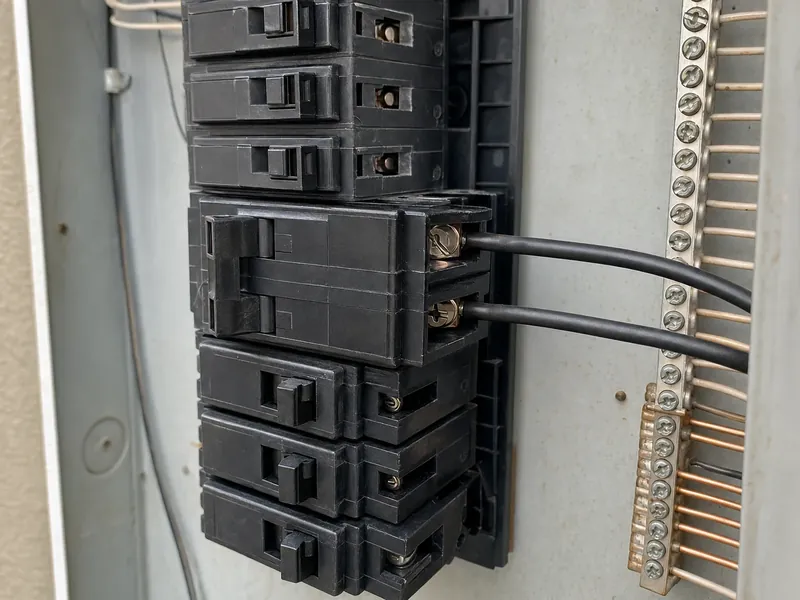
Why strip heat is what breaks the budget
The heat pump's compressor is a comparatively modest electrical load. Emergency and supplemental resistance heat is not.
| Strip heat bank | Approximate draw at 240V | Circuit |
|---|---|---|
| 5 kW | ~21 A | Single 2-pole |
| 10 kW | ~42 A | Usually two 2-pole |
| 15 kW | ~63 A | Multiple circuits, often a subpanel |
| 20 kW | ~83 A | Nearly always requires a subpanel |
A 15 kW strip bank on a 150-amp service is most of the service on its own. This is why the equipment selection and the electrical assessment are the same conversation: correct cold-climate equipment with a low balance point needs a smaller strip bank, and a smaller strip bank frequently means no service upgrade at all.
Specifying good equipment can therefore be cheaper than specifying cheap equipment, once the electrical scope is included. That is the single most useful thing to understand on this page.
What an upgrade involves on a rural mountain property
- Load calculation and a determination of the required service size.
- Coordination with the electric co-op — the meter base, service drop or lateral and any pole work are theirs, and their scheduling governs your timeline.
- Permit through the county or municipality.
- New panel, main breaker, grounding electrode system and bonding brought to current code. Older mountain homes frequently have grounding that no longer complies, and it gets corrected as part of the work.
- Transfer and re-terminate every existing circuit, replacing damaged or undersized conductors found in the process.
- Inspection, then co-op reconnection.
Rural properties add two variables that suburban jobs do not have: long service laterals from a distant pole, and older overhead drops where the co-op's portion of the work has its own lead time. Start early — the co-op's schedule, not the electrician's, is usually the critical path.
Want this run against your own delivery ticket and EMC bill? It takes one call. Free, no obligation.
Call (470) 208-3151Legitimate ways to avoid the upgrade
An upgrade is sometimes genuinely unavoidable. Often it is not, and these are the alternatives worth pricing first:
- Dual-fuel. Retain the propane furnace as the backup stage and install no strip heat at all. This removes the largest load from the calculation entirely and is the most common way a conversion proceeds on an existing service. See dual-fuel.
- Right-size the strip bank. Strip heat is routinely specified larger than the calculated backup requirement out of caution. A correct load calculation frequently reduces it a step.
- Load management devices. Listed controls that shed non-essential loads — a range, a dryer, an EV charger — when the heat pump calls, and which the NEC recognizes in the calculation.
- Retire an existing large load. Converting an electric range to induction, or removing a disused electric water heater circuit, frees calculated capacity.
Run your own numbers
Delivered-BTU math, not a marketing estimate. Change any input and the result updates.
Example only: a house burning 850 gallons at $3.20/gal through an 80% furnace, against electricity at $0.13/kWh. Backup strip heat in a hard cold snap is not modeled. Enter your own numbers above.
- Delivered heat needed
- 62.2 million BTU
- Propane cost per delivered MMBTU
- $43.71
- Heat pump cost per delivered MMBTU
- $15.29
- Electricity used
- 7,320 kWh
- This winter on propane
- $2,720
- This winter on a heat pump
- $952
Worked example at typical North Georgia prices. Change any input above and this recalculates for your house. Estimate only, not a guarantee.
Free and no obligation. You are connected to one independent, licensed, insured Georgia contractor serving your area — never a call center, never a list.
Common questions about 200A service & load calculation
Do I definitely need 200 amps?
How long does a service upgrade take?
Can I do the heat pump now and the panel later?
Where these numbers come from
- NFPA 70, National Electrical Code — service capacity, load calculation and surge protection requirements
- Amicalola EMC — current residential rates, RESP terms and program availability
Every contractor in this network holds a current Georgia Conditioned Air or Electrical Contractor license. You can confirm any license yourself before you sign anything — Georgia Secretary of State license lookup.
Get a conversion figure for your address
A photo of your panel label and meter, plus your square footage, is enough to flag a problem early.
Free and no obligation. You are connected to one independent, licensed, insured Georgia contractor serving your area — never a call center, never a list.
More in Electrical Infrastructure & Backup Power
Service capacity, strip-heat circuits, generator compatibility, and surge survival on rural EMC lines.