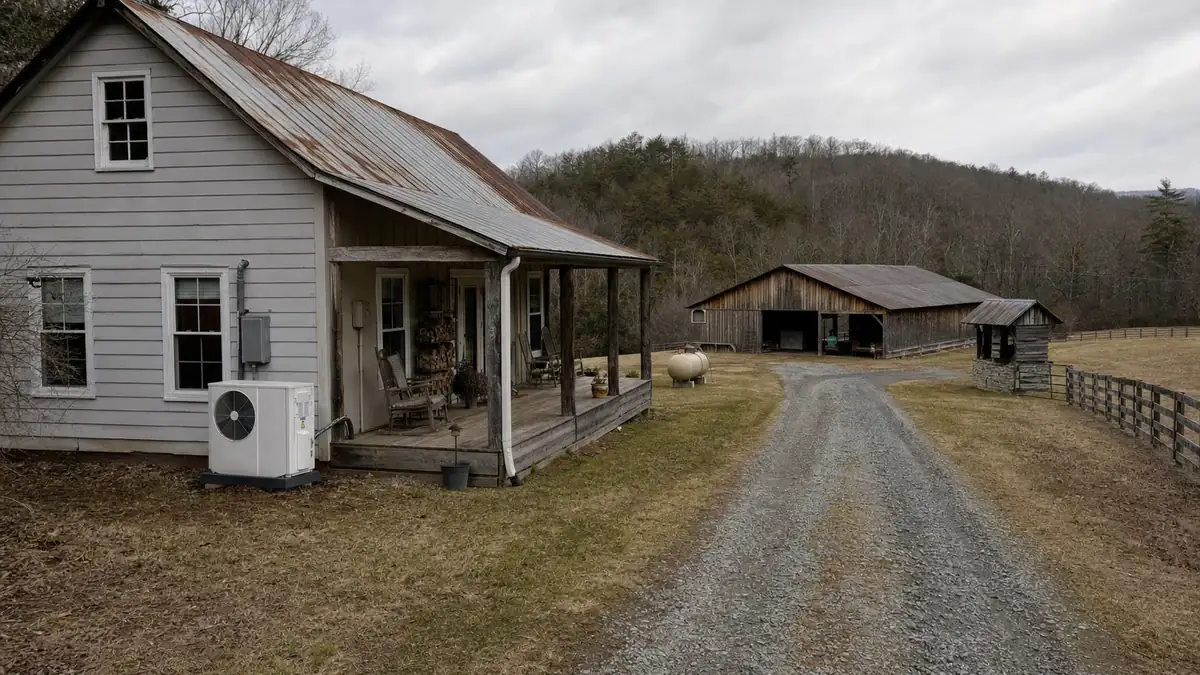
Rural acreage around Talking Rock sits outside any natural gas main, so heating is propane or electric. Converting there involves more than the house: the well pump usually drives standby generator sizing, service laterals from distant poles need voltage-drop calculation, and outbuildings left on propane keep the whole fuel account alive.
The well pump changes the backup-power conversation
On a rural acreage property the electrical service usually supplies more than lighting and appliances. It runs the well.
That matters because it reframes the standard objection to electric heat. A power outage on a well property already means no water regardless of how you heat, so the argument that 'propane keeps working when the power goes out' is weaker than it first appears — you were already exposed.
The practical conclusion is that backup power deserves to be part of the conversion conversation rather than an afterthought. A well pump is frequently a larger starting load than an inverter heat pump, so it drives the generator sizing. See generator sizing.
Long service laterals and the co-op's timeline
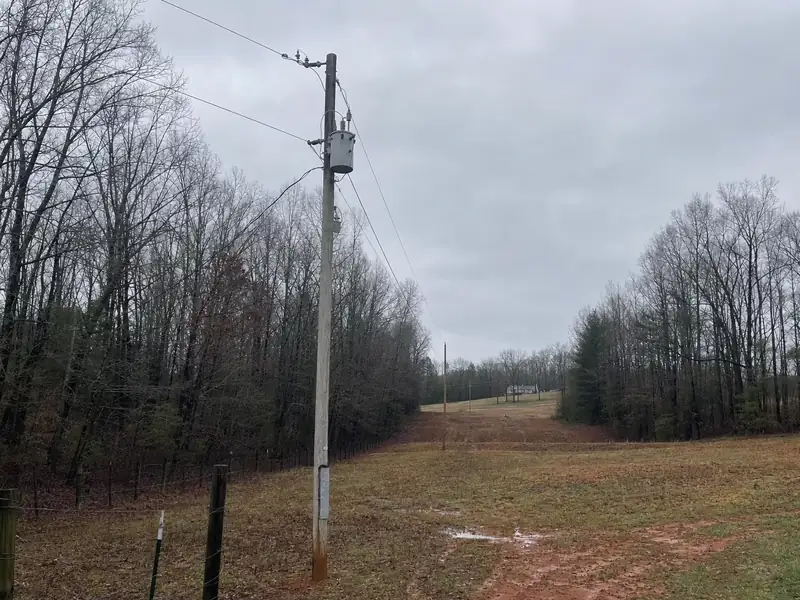
Acreage properties frequently sit a long way from the nearest pole, and that has consequences if the load calculation calls for a service upgrade:
- Long runs mean voltage-drop calculations and larger conductors than the ampacity alone would suggest.
- The cooperative's portion — transformer, drop or lateral, meter base — runs on their schedule, and on a remote property that can be the longest lead item in the whole project.
- Existing service on older acreage properties is often 100 or 150 amps installed decades ago for a house that had a propane furnace and little else.
- Grounding electrode systems on older rural installations frequently do not meet current requirements and get corrected as part of the work.
Start the electrical assessment first on these properties. It is the item most likely to set your completion date.
Want this run against your own delivery ticket and EMC bill? It takes one call. Free, no obligation.
Call (470) 208-3151Outbuildings: the load nobody includes in the quote
Acreage properties come with structures the main system was never intended to serve — workshops, equipment barns, studios, garage apartments, well houses.
- Workshops and equipment barns
- Usually best served by a dedicated single-zone ductless unit run seasonally or on demand, rather than by extending anything from the house.
- Garage apartments and studios
- Independent occupancy means independent control. A separate zone is both cheaper and better than trying to share a thermostat.
- Well houses and pump enclosures
- Do not need conditioning, but do need freeze protection. Worth confirming what protects yours before the first hard freeze.
- Detached guest quarters
- Frequently on their own propane appliance entirely. Include it in the conversion scope or you will keep a fuel account alive for one building.
The reason to inventory these at quote stage is the tank decision. If one outbuilding stays on propane, you keep the tank, the lease and the delivery minimums — which undoes much of the point.
Delivery access is the argument that closes here
Long unpaved drives, seasonal creek crossings, and grades that a loaded bobtail cannot climb in wet or icy conditions are the norm rather than the exception on these properties.
If you have ever had a delivery refused, rescheduled or completed only part-way, that experience is the strongest single argument for conversion — stronger than the fuel arithmetic. Electricity does not require anyone to drive up your hill. See delivery reliability.
Run your own numbers
Delivered-BTU math, not a marketing estimate. Change any input and the result updates.
Example only: a house burning 850 gallons at $3.20/gal through an 80% furnace, against electricity at $0.13/kWh. Backup strip heat in a hard cold snap is not modeled. Enter your own numbers above.
- Delivered heat needed
- 62.2 million BTU
- Propane cost per delivered MMBTU
- $43.71
- Heat pump cost per delivered MMBTU
- $15.29
- Electricity used
- 7,320 kWh
- This winter on propane
- $2,720
- This winter on a heat pump
- $952
Worked example at typical North Georgia prices. Change any input above and this recalculates for your house. Estimate only, not a guarantee.
Free and no obligation. You are connected to one independent, licensed, insured Georgia contractor serving your area — never a call center, never a list.
Common questions about Talking Rock & rural acreage
I have a well. Does converting to electric heat make an outage worse?
Can you condition my workshop as part of the conversion?
My driveway is a mile of gravel. Is that a problem for installation?
Where these numbers come from
- NOAA U.S. Climate Normals — station data behind the 13-18°F design temperature range
- NFPA 70, National Electrical Code — service capacity, load calculation and surge protection requirements
Every contractor in this network holds a current Georgia Conditioned Air or Electrical Contractor license. You can confirm any license yourself before you sign anything — Georgia Secretary of State license lookup.
Get a conversion figure for your address
List every building on the property when you call. Outbuildings are what decide whether the tank can actually leave.
Free and no obligation. You are connected to one independent, licensed, insured Georgia contractor serving your area — never a call center, never a list.
More in Mountain Enclaves We Serve
Gate logistics, architectural review, slope staging, and microclimate load differences by community.
Cluster hubBig Canoe →