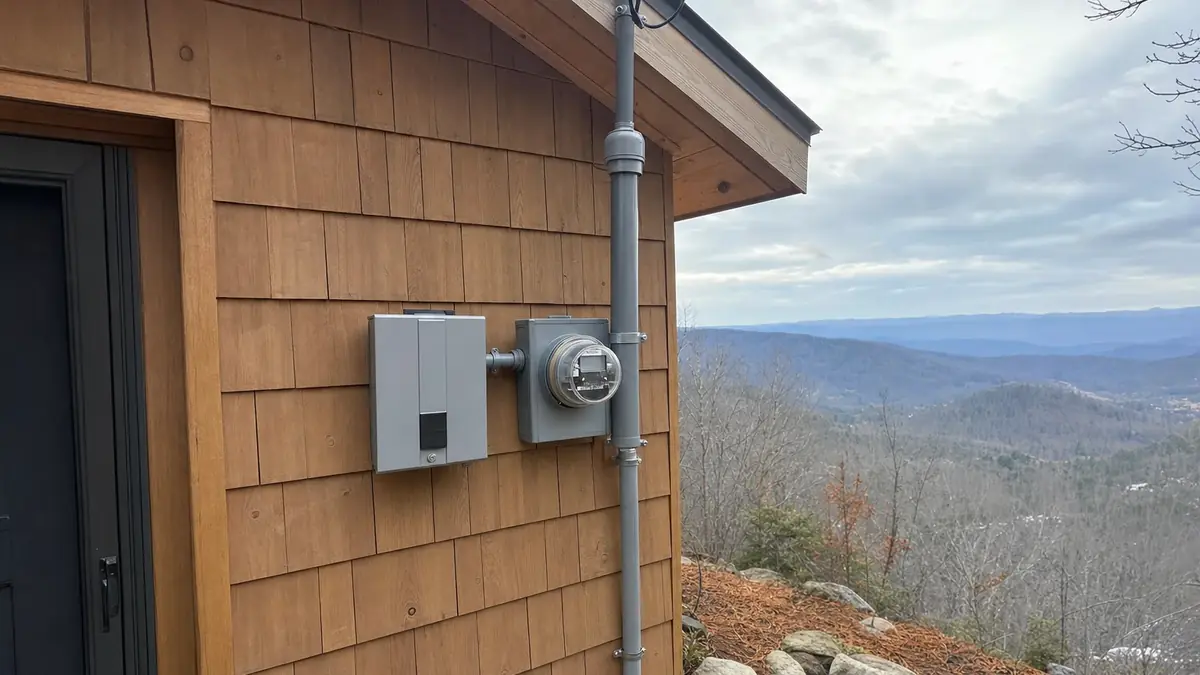
Inverter heat pumps use variable-frequency drives and control boards that are far more sensitive to electrical transients than the contactor-and-capacitor equipment they replace. Protection is layered: a Type 1 device at the service entrance for external surges, a Type 2 at the panel, and an equipment-level device at the heat pump disconnect. Manufacturer warranties generally exclude surge damage.
Where the transients come from
- Direct and nearby lightning
- North Georgia has substantial thunderstorm activity, and elevated ridge-top structures are preferentially exposed. A strike need not hit the house — a nearby strike induces a surge on the service conductors.
- Line events on rural feeders
- Long overhead distribution through tree canopy produces recloser operations, momentary faults and switching transients. Each is a voltage event arriving at your panel.
- Internally generated surges
- Well pumps, compressors and other inductive loads switching off inside the house generate their own transients. These are lower magnitude but far more frequent, and the cumulative degradation is real.
The failure mode is rarely dramatic. Boards degrade through repeated small events and fail some months later, typically during a cold snap when the equipment is working hardest — and long after anyone connects the failure to the storm that started it.
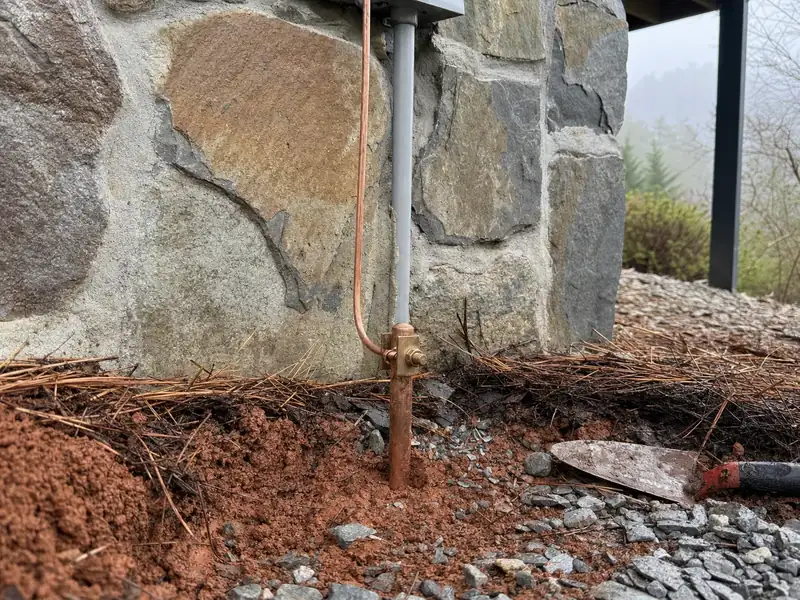
How protection is layered
Surge protection is a cascade, not a single device. Each stage handles what the previous one passes through:
- Type 1 SPD — installed on the line side of the main disconnect, at the meter or service entrance. Handles the largest external events, including lightning-induced surges arriving on the service. This is the stage that matters most on an exposed rural property.
- Type 2 SPD — installed at the panel on the load side of the main breaker. Protects branch circuits from what gets through, and from internally generated transients.
- Equipment-level protection — a dedicated SPD at the heat pump disconnect, protecting the specific asset you care most about. Inexpensive relative to a drive board.
- Point-of-use protection — for the thermostat and any communicating controls, which sit on low-voltage wiring that can carry its own induced transients.
Want this run against your own delivery ticket and EMC bill? It takes one call. Free, no obligation.
Call (470) 208-3151What to specify
- A device listed to UL 1449 in its current edition, at the appropriate type for its position in the cascade.
- Surge current capacity appropriate to exposure — a ridge-top property warrants more than a sheltered valley site.
- A low voltage protection rating, which is the let-through voltage the downstream equipment actually sees. Lower is better, and this figure matters more than the headline kiloamp rating.
- Status indication, so a device that has done its job and expired is visible rather than silently absent.
- A manufacturer's connected-equipment warranty, read for its exclusions.
The CSST interaction, if you are keeping any gas
If your house has corrugated stainless steel tubing for propane and you are retaining any gas appliance, bonding requirements deserve specific attention. CSST has documented vulnerability to arcing from nearby lightning where bonding is inadequate, and manufacturers publish requirements for direct bonding to the grounding electrode system.
This is worth verifying during any electrical work at a mountain property, and it is a natural point to check it because the panel is already open. See gas line work.
Run your own numbers
Delivered-BTU math, not a marketing estimate. Change any input and the result updates.
Example only: a house burning 850 gallons at $3.20/gal through an 80% furnace, against electricity at $0.13/kWh. Backup strip heat in a hard cold snap is not modeled. Enter your own numbers above.
- Delivered heat needed
- 62.2 million BTU
- Propane cost per delivered MMBTU
- $43.71
- Heat pump cost per delivered MMBTU
- $15.29
- Electricity used
- 7,320 kWh
- This winter on propane
- $2,720
- This winter on a heat pump
- $952
Worked example at typical North Georgia prices. Change any input above and this recalculates for your house. Estimate only, not a guarantee.
Free and no obligation. You are connected to one independent, licensed, insured Georgia contractor serving your area — never a call center, never a list.
Common questions about surge protection for inverter HVAC
Is surge protection really necessary, or is it an upsell?
Does my equipment warranty cover surge damage?
Will a plug-in surge strip protect the heat pump?
Where these numbers come from
- NFPA 70, National Electrical Code — service capacity, load calculation and surge protection requirements
- Amicalola EMC — current residential rates, RESP terms and program availability
Every contractor in this network holds a current Georgia Conditioned Air or Electrical Contractor license. You can confirm any license yourself before you sign anything — Georgia Secretary of State license lookup.
Get a conversion figure for your address
If your property is on a ridge or at the end of a long feeder, ask us to price protection with the system rather than after it.
Free and no obligation. You are connected to one independent, licensed, insured Georgia contractor serving your area — never a call center, never a list.
More in Electrical Infrastructure & Backup Power
Service capacity, strip-heat circuits, generator compatibility, and surge survival on rural EMC lines.
Cluster hub200A service & load calculation →