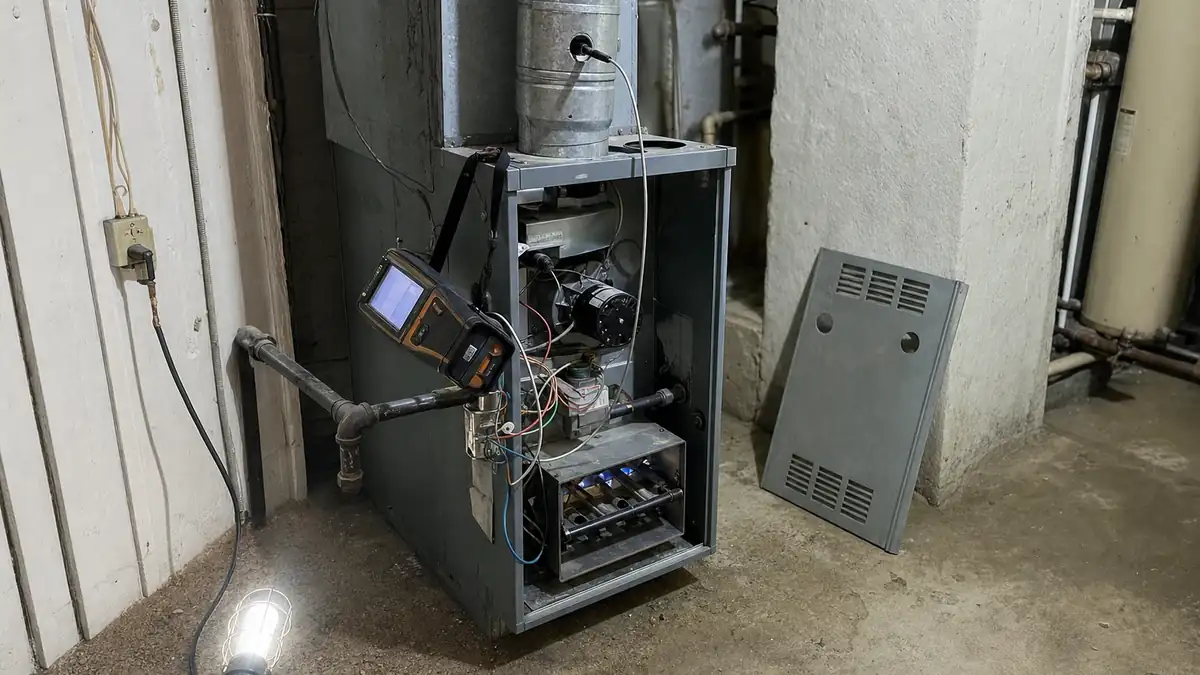
A cracked heat exchanger lets combustion gases including carbon monoxide enter the air the blower circulates. Cracks come from thermal fatigue and are accelerated by short cycling. Detection requires borescope inspection and combustion analysis, not observation — carbon monoxide has no smell or color. Heat pumps have no combustion, so this failure mode does not exist.
How a heat exchanger fails
The heat exchanger is a metal chamber. Flame and exhaust gas are on the inside; the air your blower pushes through the ducts passes over the outside. The metal is the only barrier.
It fails through thermal fatigue. Every ignition heats the metal rapidly and every shutdown cools it, and repeated expansion and contraction eventually opens stress cracks — typically at bends and welds. Corrosion from condensation accelerates it, which is why damp crawlspace installations common in this county are harder on equipment than a conditioned closet would be.
Symptoms, and the reason you cannot rely on them
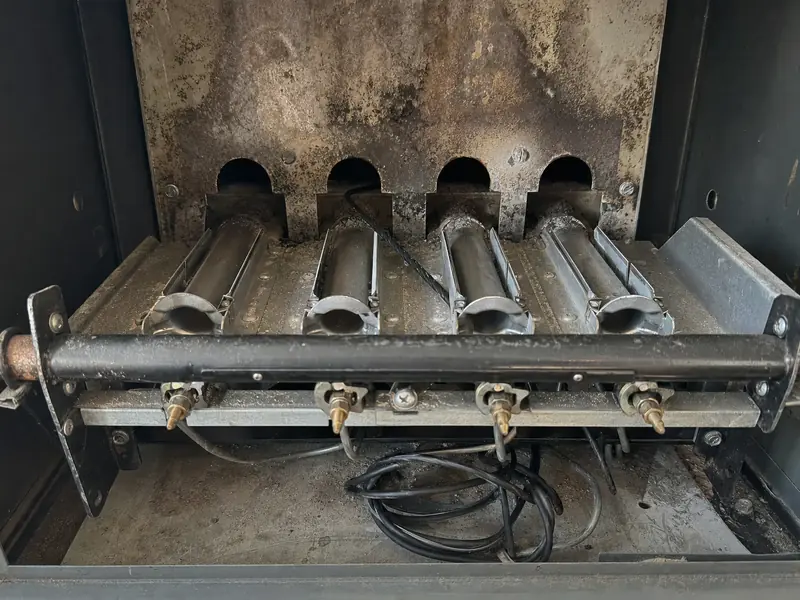
- Soot or scorching around the burner compartment or flue connection.
- A flame that shifts, rolls or changes color when the blower starts — a classic indicator of a breach.
- Persistent headaches, nausea, dizziness or fatigue that improve when you leave the house and return when you come back.
- Unexplained moisture on windows near the furnace.
- A CO alarm activating, at any level, even once.
- Visible rust or corrosion on the exchanger surface or in the vestibule.
The difficulty is that a cracked exchanger commonly produces no symptom you would notice, and carbon monoxide has no smell, color or taste. Detection is by instrument or by inspection, not by attentiveness. That is the whole reason the hazard is treated as seriously as it is.
What a real inspection involves
A meaningful combustion safety inspection is not a visual glance at the burner. It should include:
- Visual examination of accessible exchanger surfaces, often with a borescope through the burner or collector ports.
- Combustion analysis at the flue, measuring CO in the exhaust stream against manufacturer limits.
- A draft and spillage test, verifying the flue actually pulls under real operating conditions.
- A worst-case depressurisation test — every exhaust fan, dryer and range hood running, doors closed — to see whether the house can be made to backdraft the furnace.
- Ambient CO measurement in the living space.
If a heat exchanger is confirmed breached, the correct response is to shut the appliance down and replace it. Exchangers are not repaired.
Want this run against your own delivery ticket and EMC bill? It takes one call. Free, no obligation.
Call (470) 208-3151Backdrafting: the mountain-specific risk
Even a perfect heat exchanger only helps if the flue works. A naturally-drafting appliance relies on buoyancy to carry exhaust up and out, and that draft is fragile.
Several conditions common in this county work against it: a tight house with powerful kitchen and bath exhaust that depressurises the space; a flue in an exterior masonry chimney that stays too cold to establish draft; wind loading on a ridge-top or saddle site producing downdraft; and an oversized flue left behind after a smaller appliance replaced a larger one.
Wood stoves and gas fireplaces competing for the same combustion air add another vector, and those are common in cabins here.
What conversion actually removes
A heat pump has no flame, no flue, no exhaust gases and no heat exchanger in the combustion sense. The entire failure mode described on this page ceases to exist for the heating system.
Air quality improves in a second, quieter way as well. Combustion appliances produce nitrogen dioxide and fine particulates alongside CO, at levels below any alarm threshold but not below relevance for asthmatic or elderly occupants. Removing combustion removes that too.
Run your own numbers
Delivered-BTU math, not a marketing estimate. Change any input and the result updates.
Example only: a house burning 850 gallons at $3.20/gal through an 80% furnace, against electricity at $0.13/kWh. Backup strip heat in a hard cold snap is not modeled. Enter your own numbers above.
- Delivered heat needed
- 62.2 million BTU
- Propane cost per delivered MMBTU
- $43.71
- Heat pump cost per delivered MMBTU
- $15.29
- Electricity used
- 7,320 kWh
- This winter on propane
- $2,720
- This winter on a heat pump
- $952
Worked example at typical North Georgia prices. Change any input above and this recalculates for your house. Estimate only, not a guarantee.
Free and no obligation. You are connected to one independent, licensed, insured Georgia contractor serving your area — never a call center, never a list.
Common questions about combustion safety & CO
My CO alarm has never gone off. Does that mean the furnace is fine?
How often should a propane furnace be inspected?
If I convert, do I still need carbon monoxide alarms?
Where these numbers come from
- NFPA 58, Liquefied Petroleum Gas Code — the code governing tank removal, abandonment and purging
Every contractor in this network holds a current Georgia Conditioned Air or Electrical Contractor license. You can confirm any license yourself before you sign anything — Georgia Secretary of State license lookup.
Get a conversion figure for your address
If your furnace is over fifteen years old, ask for combustion analysis at the quote visit. We do it as part of the assessment.
Free and no obligation. You are connected to one independent, licensed, insured Georgia contractor serving your area — never a call center, never a list.
More in Propane Infrastructure & Tank Removal
Getting the tank, the lease, and the gas piping off your property legally and permanently.
Cluster hubTank removal & abandonment →