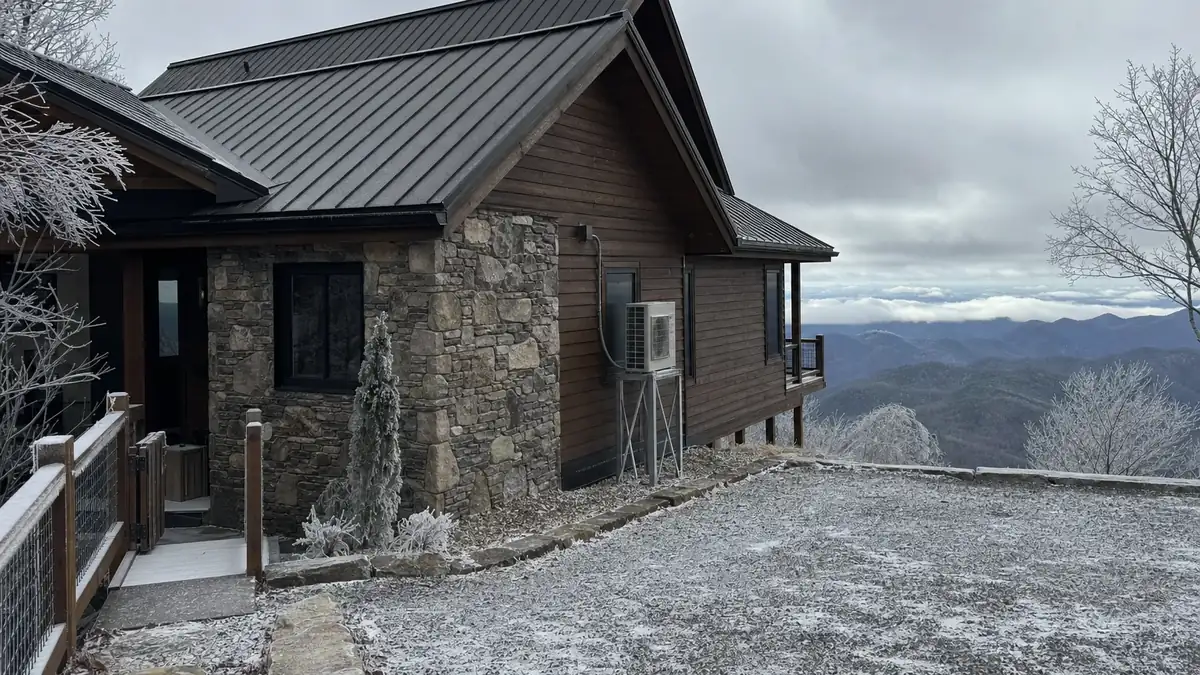
Burnt Mountain is the highest terrain in Pickens County, and above 2,000 feet design temperature falls roughly 5-8°F against the metro baseline once wind exposure is included. Rime ice, roof shed and outage-prone distribution lines all affect equipment placement. Dual-fuel is often preferred here because a combustion backup stage does not depend on grid power.
What changes above 2,000 feet
- Design temperature
- Falls materially against the metro baseline — commonly 5–8°F once elevation and exposure are combined. This shifts equipment selection, not just sizing.
- Wind loading
- Exposed upper-slope and ridge sites carry infiltration loads that a sheltered house of identical construction simply does not have. Wind-driven infiltration is frequently the largest single line in the load calculation up here.
- Icing and rime
- Freezing fog and rime accumulation occur at elevations where the valley below stays clear. This affects outdoor unit placement, defrost behavior and clearance requirements.
- Outage exposure
- Distribution lines through mature tree canopy on steep terrain are the most outage-prone configuration on the cooperative's system, and restoration takes longer because access is harder.
- Access
- The constraint on installation, on service calls, and on propane delivery alike. In genuinely bad conditions a property may be unreachable by any commercial vehicle for days.
Why we often recommend dual-fuel here specifically
Across most of the county we treat dual-fuel as one option among several. On the upper slopes of Burnt Mountain we lean toward it, for reasons that are about resilience rather than arithmetic:
- A combustion backup stage that does not depend on grid power provides genuine redundancy on the most outage-prone terrain in the county.
- Retaining the furnace means no strip-heat circuits, which frequently avoids a service upgrade on properties where the service lateral run from the pole is long and expensive to enlarge.
- You still eliminate the large majority of propane consumption, so the delivery-frequency problem shrinks dramatically even though the tank stays.
- It is reversible. Completing the conversion later, when the furnace reaches end of life, remains available.
Want this run against your own delivery ticket and EMC bill? It takes one call. Free, no obligation.
Call (470) 208-3151Outdoor unit placement at elevation
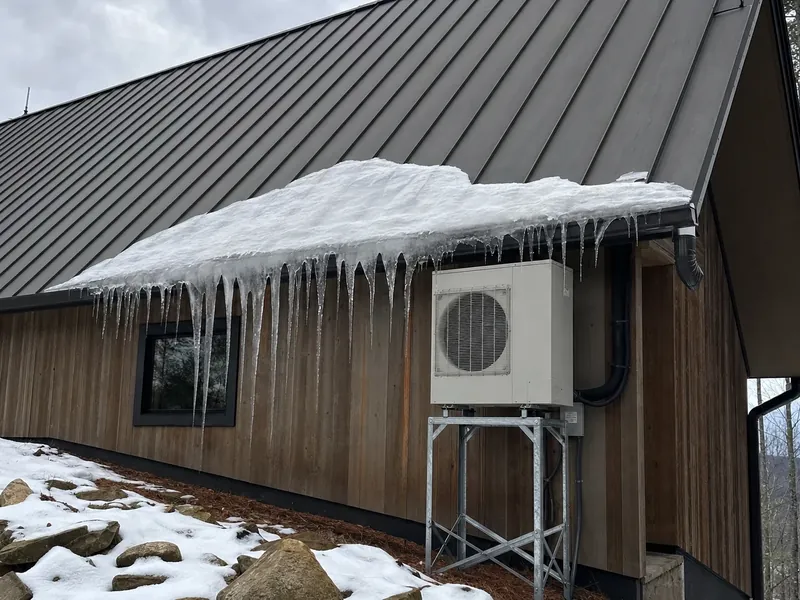
- Mount high. Snow and rime accumulation, plus meltwater that refreezes, argue for substantially more ground clearance than a standard pad provides.
- Get out of the prevailing wind. Direct wind loading on the coil degrades performance and increases frost formation. Where the site allows, place the unit on a sheltered elevation.
- Clear the roof shed line. An ice sheet releasing from a metal roof onto a condensing unit destroys it. This is the most common physical damage we see at elevation.
- Preserve service access in winter. A unit that cannot be reached in February is a unit that cannot be repaired in February.
- Drain positively away from the base. Defrost meltwater on a shaded upper-slope site does not evaporate — it accumulates and freezes.
Specification summary for upper-slope properties
Everything on this page converges on a short list. On the upper slopes we specify:
| Item | Specification |
|---|---|
| Equipment | Cold-climate inverter with published capacity at 5°F and rated operation below 0°F |
| Load calculation | Site-specific design temperature with wind exposure explicitly included |
| Defrost | Demand-initiated, not timed |
| Mounting | Elevated bracket or stand, clear of roof shed, positively drained |
| Backup | Dual-fuel preferred; otherwise standby generator, not optional |
| Surge protection | Layered Type 1 and Type 2, per surge protection |
| Controls | Manufacturer-matched controller preserving full modulation |
Run your own numbers
Delivered-BTU math, not a marketing estimate. Change any input and the result updates.
Example only: a house burning 850 gallons at $3.20/gal through an 80% furnace, against electricity at $0.13/kWh. Backup strip heat in a hard cold snap is not modeled. Enter your own numbers above.
- Delivered heat needed
- 62.2 million BTU
- Propane cost per delivered MMBTU
- $43.71
- Heat pump cost per delivered MMBTU
- $15.29
- Electricity used
- 7,320 kWh
- This winter on propane
- $2,720
- This winter on a heat pump
- $952
Worked example at typical North Georgia prices. Change any input above and this recalculates for your house. Estimate only, not a guarantee.
Free and no obligation. You are connected to one independent, licensed, insured Georgia contractor serving your area — never a call center, never a list.
Common questions about Burnt Mountain
Is a heat pump really viable at 2,500 feet in Georgia?
Should I keep my propane furnace as backup up here?
What happens if I lose power for three days in an ice storm?
Where these numbers come from
- NOAA U.S. Climate Normals — station data behind the 13-18°F design temperature range
- NEEP Cold Climate Air Source Heat Pump Product List — capacity actually retained at 5°F, by model
Every contractor in this network holds a current Georgia Conditioned Air or Electrical Contractor license. You can confirm any license yourself before you sign anything — Georgia Secretary of State license lookup.
Get a conversion figure for your address
At this elevation dual-fuel is often the better engineering answer than a full conversion.
Free and no obligation. You are connected to one independent, licensed, insured Georgia contractor serving your area — never a call center, never a list.
More in Mountain Enclaves We Serve
Gate logistics, architectural review, slope staging, and microclimate load differences by community.
Cluster hubBig Canoe →