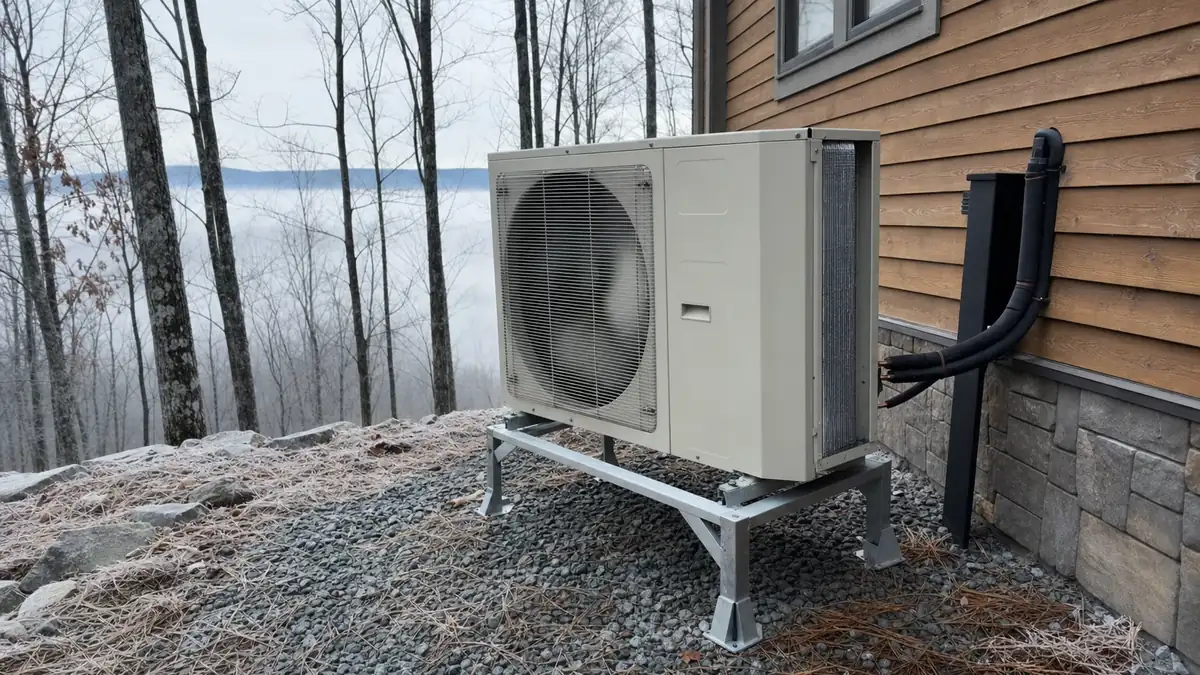
A cold-climate inverter heat pump holds close to its rated capacity at 5°F, where a single-stage unit delivers only 40-55% and hands the load to resistance strip heat. Pickens County design temperature is 13-18°F depending on elevation, comfortably inside a cold-climate unit's operating envelope and outside a standard unit's.
What actually happens to a heat pump as it gets colder
A heat pump extracts heat from outdoor air. As outdoor temperature falls, there is less heat available per unit of air moved, refrigerant density at the compressor inlet drops, and delivered capacity falls with it. That much is true of every heat pump ever built.
The engineering question is what the equipment does about it. A single-stage compressor has one speed. It cannot compensate, so its capacity curve simply falls away, and by the time it reaches the temperatures Pickens County sees in January it is delivering roughly half its nameplate rating — at exactly the moment the house needs the most.
An inverter-driven compressor varies speed continuously. As it gets colder, it speeds up. Cold-climate models pair that with vapour injection or enhanced-vapour-injection scroll designs specifically to hold rated capacity far down the curve.
| Outdoor temp | Single-stage capacity | Cold-climate inverter |
|---|---|---|
| 47°F (rating point) | 100% | 100% |
| 35°F | 78–85% | 100%+ |
| 17°F | 55–65% | 95–100% |
| 5°F | 40–55% | ~100% on qualifying models |
| −5°F | Typically not rated | 70–85% |
The balance point is the number to ask about
Balance point is the outdoor temperature at which the heat pump's delivered capacity exactly equals the house's heat loss. Above it, the heat pump carries the house alone. Below it, something else has to make up the difference — strip heat, or a propane furnace in a dual-fuel arrangement.
This single number drives your operating cost more than the efficiency rating does. A system with a balance point of 32°F will run supplemental heat through a large share of a Pickens winter. The same house with correctly selected cold-climate equipment can land a balance point in the mid-teens, which puts supplemental heat into a handful of mornings per season.
Ask any contractor quoting you: what balance point does this selection produce on my Manual J? If they cannot answer, they have not done one. See load sizing.
Want this run against your own delivery ticket and EMC bill? It takes one call. Free, no obligation.
Call (470) 208-3151Specifications worth reading, and the one that misleads
- Capacity at 5°F
- The number that matters here. Published in the extended ratings, not on the marketing sheet.
- HSPF2
- Seasonal heating efficiency. Useful for comparing two units, but computed against a national climate region — it does not describe your ridge.
- Maximum operating temperature range
- Confirm the unit is rated to operate, not merely survive, below 0°F.
- Defrost strategy
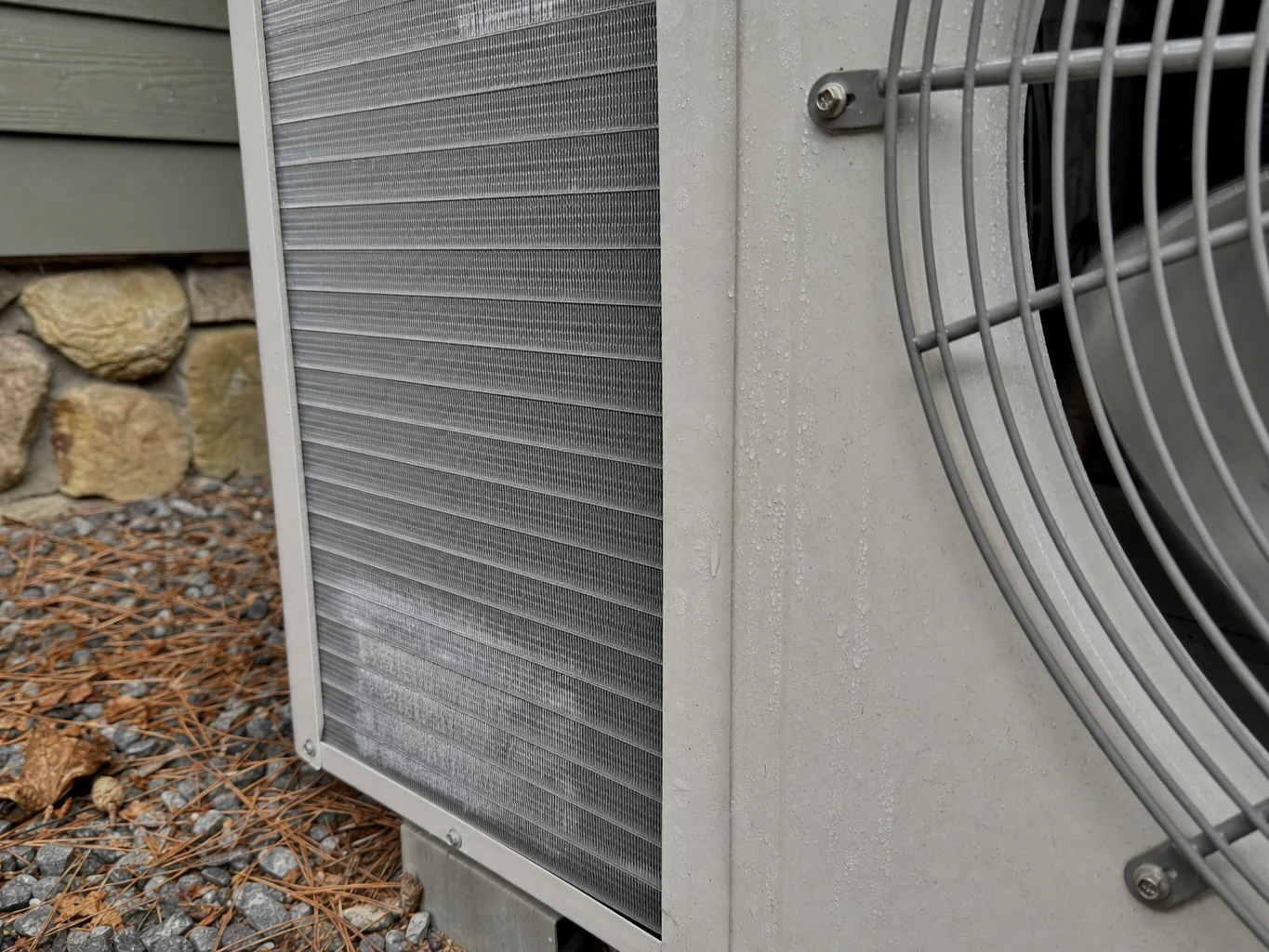
- Demand-defrost outperforms timed defrost, and matters more at elevation where humidity and frost cycling are higher.
- Turndown ratio
- How far the compressor can modulate down. High turndown is what produces long, low, even runtimes instead of cycling.
- SEER2
- Cooling efficiency. Largely irrelevant to this decision, and reliably the first number a salesperson leads with.
Elevation, exposure and why two identical houses need different systems
Design temperature falls roughly 3–5°F between Jasper at around 1,500 feet and the higher shoulders of Burnt Mountain. That alone shifts the equipment selection.
Exposure compounds it. A ridge-top house with prevailing winter wind on its long elevation carries a materially higher infiltration load than an identical floor plan in a sheltered hollow — and a cold-hollow house has its own problem, which is cold-air drainage pooling on still nights. Both are real, both are local, and neither shows up in a square-footage rule of thumb.
This is the practical reason no competent contractor quotes equipment over the phone.
Run your own numbers
Delivered-BTU math, not a marketing estimate. Change any input and the result updates.
Example only: a house burning 850 gallons at $3.20/gal through an 80% furnace, against electricity at $0.13/kWh. Backup strip heat in a hard cold snap is not modeled. Enter your own numbers above.
- Delivered heat needed
- 62.2 million BTU
- Propane cost per delivered MMBTU
- $43.71
- Heat pump cost per delivered MMBTU
- $15.29
- Electricity used
- 7,320 kWh
- This winter on propane
- $2,720
- This winter on a heat pump
- $952
Worked example at typical North Georgia prices. Change any input above and this recalculates for your house. Estimate only, not a guarantee.
Free and no obligation. You are connected to one independent, licensed, insured Georgia contractor serving your area — never a call center, never a list.
Common questions about cold-climate inverter heat pumps
Do I need a cold-climate model, or is a standard heat pump enough?
Will I hear it running all the time?
What happens in an ice storm when it is 8°F for three days?
Where these numbers come from
- NEEP Cold Climate Air Source Heat Pump Product List — capacity actually retained at 5°F, by model
- AHRI Directory of Certified Product Performance — verify any quoted HSPF2, SEER2 and capacity rating
- NOAA U.S. Climate Normals — station data behind the 13-18°F design temperature range
Every contractor in this network holds a current Georgia Conditioned Air or Electrical Contractor license. You can confirm any license yourself before you sign anything — Georgia Secretary of State license lookup.
Get a conversion figure for your address
Ask for the extended capacity table on whatever you are quoted. A contractor who will not produce it is telling you something.
Free and no obligation. You are connected to one independent, licensed, insured Georgia contractor serving your area — never a call center, never a list.
More in Equipment & Mountain Engineering
Capacity retention at design temp, hybrid architectures, and load sizing for homes above 1,800 feet.