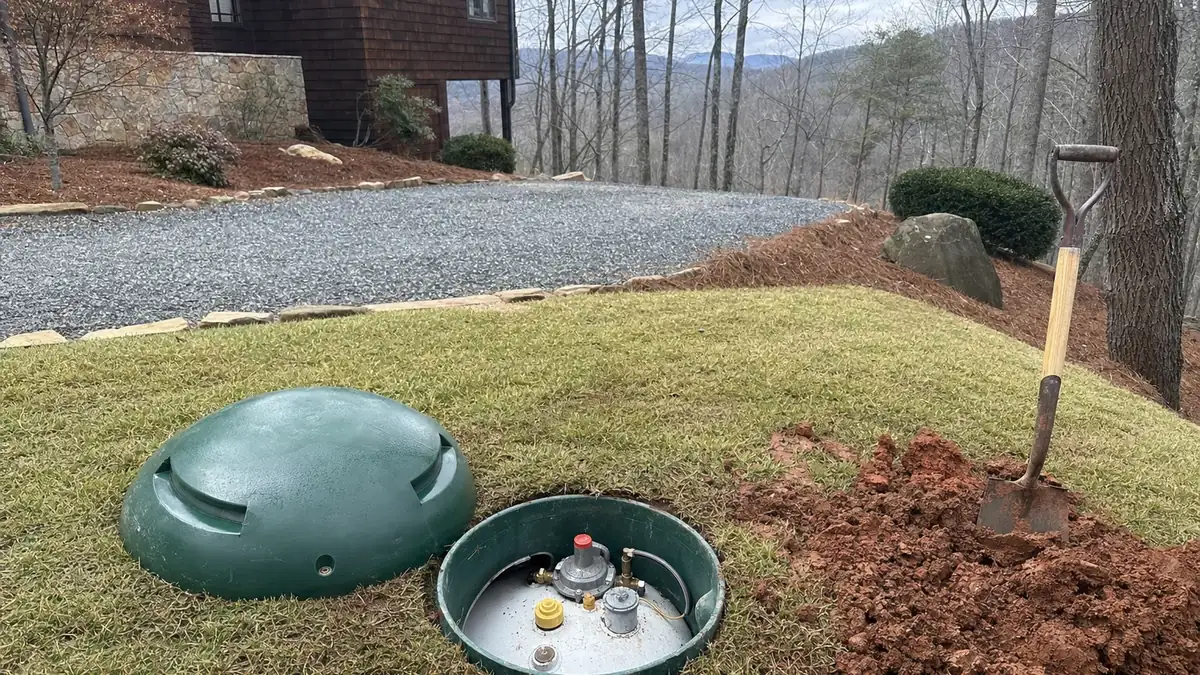
A propane tank has three legitimate end states: supplier removal if leased, full extraction if owned, or code-compliant abandonment in place for a buried tank where excavation would damage a septic field or driveway. All three require purging the vessel to a verifiably non-flammable atmosphere first, under NFPA 58. Keep the completion documentation permanently.
Establish these two facts before anything else
- Do you own the tank, or is it leased? If it is leased, it is the supplier's property and only they may remove it. You cannot hire a third party to take it, and doing so creates a genuine liability. See the lease page.
- Is it above ground or buried? An above-ground tank is a straightforward purge-and-lift. An underground tank opens a separate set of options and obligations.
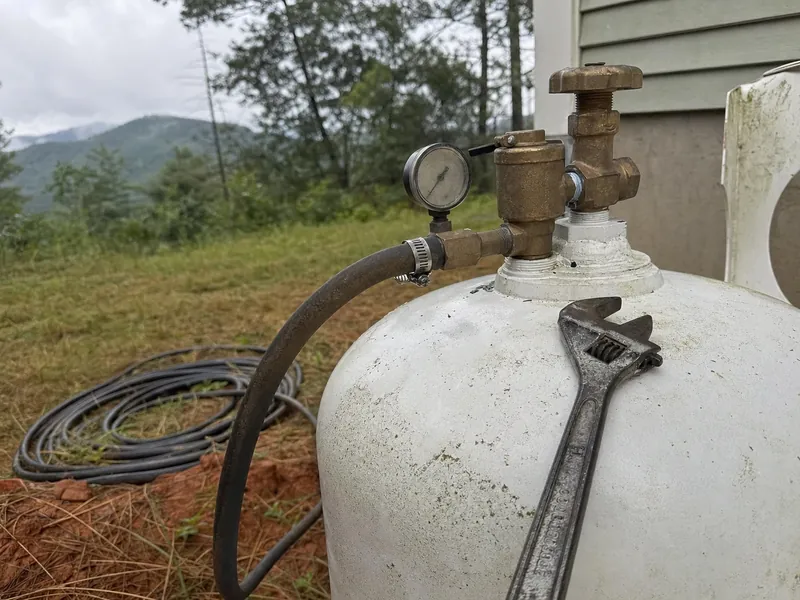
The three legitimate end states
- Supplier removal (leased tanks)
- The supplier schedules a pump-out of remaining product, purges the vessel, disconnects it and hauls it away. Terms on remaining fuel, removal fees and notice periods are set by your lease.
- Full extraction (owned tanks)
- Vessel is emptied, purged of vapour to a safe concentration, disconnected, excavated if buried, and removed. The cleanest outcome and the one that leaves no future disclosure obligation.
- Abandonment in place (buried tanks only)
- Where excavation would damage a septic field, a retaining wall, a driveway or mature landscaping, a buried tank may be permanently decommissioned in place: emptied, purged and rendered inert, fittings removed or permanently sealed, and the vessel filled with an inert material such as sand or flowable fill so it cannot collapse or migrate.
The fourth option — disconnecting the line and leaving a charged or unpurged tank in the ground — is not an end state. It is a deferred problem that will surface at your next property sale, and it is the condition we most often find on mountain properties that changed hands two or three owners ago.
Purging is the safety-critical step
An 'empty' propane tank is not empty. It contains propane vapour, and a vessel containing vapour and air within the flammable range is far more dangerous than a full one. Every legitimate decommissioning sequence handles this the same way:
- Remaining liquid is pumped out or burned off to the lowest practical level.
- The vessel is vapour-purged, commonly with an inert gas, until the internal atmosphere is verifiably outside the flammable range.
- Purge completion is confirmed by measurement, not assumption.
- Only then are fittings removed, or the vessel cut, lifted or filled.
This work falls under NFPA 58, the Liquefied Petroleum Gas Code, which Georgia adopts, and it is performed by personnel qualified and equipped for it. Anyone offering to cut into or excavate a tank that has not been verifiably purged should be removed from your property.
Want this run against your own delivery ticket and EMC bill? It takes one call. Free, no obligation.
Call (470) 208-3151Local requirements and the paperwork that matters later
Requirements vary by jurisdiction and change. Before work begins, confirm directly with Pickens County and, if you are inside a municipality, the city:
- Whether a permit is required for removal or for abandonment in place.
- Whether abandonment in place is permitted at all for your tank size and location, and what fill material is acceptable.
- Whether inspection or sign-off is required before backfill.
- What documentation is issued on completion.
Keep the completion documentation permanently. At resale, a buyer's inspector who finds evidence of a buried tank will ask what happened to it, and 'the previous owner said it was fine' is not an answer that closes a transaction. In a gated community there may also be an architectural or environmental committee with its own requirements — see the Big Canoe page.
Sequence it in this order
- New heating system installed, commissioned and verified working through at least one genuinely cold night.
- Gas piping capped and pressure-tested. See gas line capping.
- Supplier notified, lease terminated, final pump-out scheduled.
- Tank purged, then removed or abandoned to code.
- Site restored, documentation filed with your property records.
Run your own numbers
Delivered-BTU math, not a marketing estimate. Change any input and the result updates.
Example only: a house burning 850 gallons at $3.20/gal through an 80% furnace, against electricity at $0.13/kWh. Backup strip heat in a hard cold snap is not modeled. Enter your own numbers above.
- Delivered heat needed
- 62.2 million BTU
- Propane cost per delivered MMBTU
- $43.71
- Heat pump cost per delivered MMBTU
- $15.29
- Electricity used
- 7,320 kWh
- This winter on propane
- $2,720
- This winter on a heat pump
- $952
Worked example at typical North Georgia prices. Change any input above and this recalculates for your house. Estimate only, not a guarantee.
Free and no obligation. You are connected to one independent, licensed, insured Georgia contractor serving your area — never a call center, never a list.
Common questions about tank removal & abandonment
Can I just leave the underground tank where it is?
Who pays for removal?
Is the tank worth anything?
Where these numbers come from
- NFPA 58, Liquefied Petroleum Gas Code — the code governing tank removal, abandonment and purging
Every contractor in this network holds a current Georgia Conditioned Air or Electrical Contractor license. You can confirm any license yourself before you sign anything — Georgia Secretary of State license lookup.
Get a conversion figure for your address
Have the decommissioning sequence coordinated with your supplier so the tank leaves after the heat works, not before.
Free and no obligation. You are connected to one independent, licensed, insured Georgia contractor serving your area — never a call center, never a list.
More in Propane Infrastructure & Tank Removal
Getting the tank, the lease, and the gas piping off your property legally and permanently.