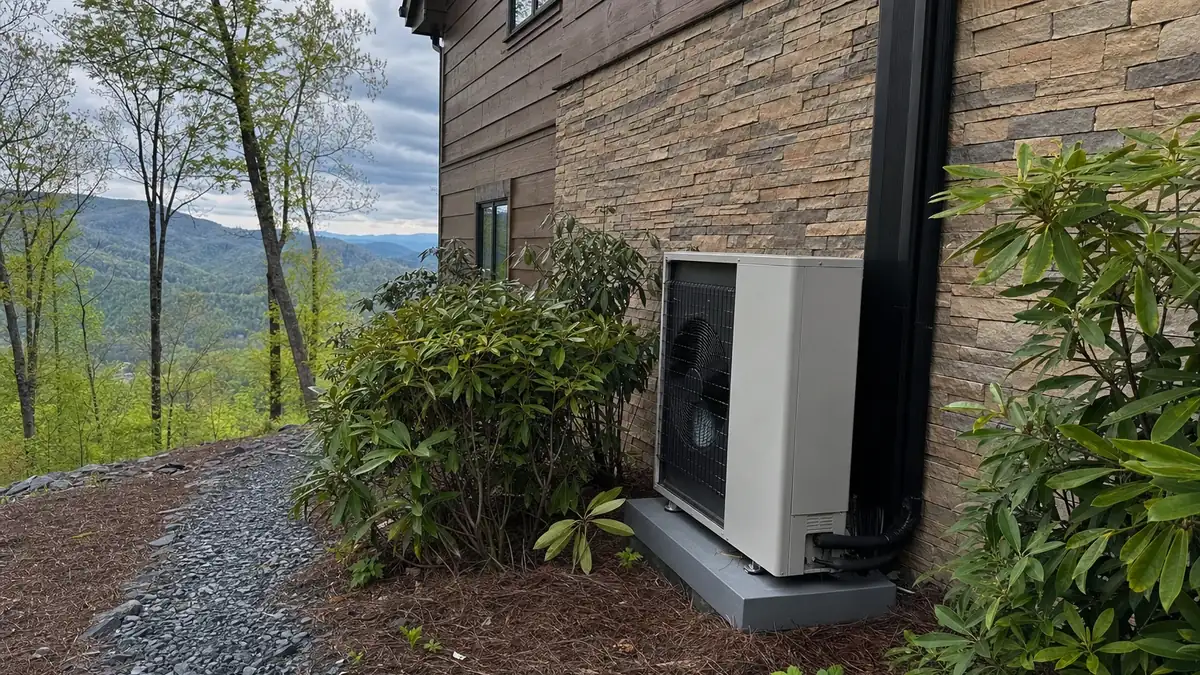
Converting a Big Canoe home from propane requires architectural review before installation, because a new outdoor condensing unit is an exterior modification. Gate access for trade vehicles is arranged in advance through the property owners' association. Elevation across the community runs roughly 1,800-2,800 feet, which lowers design temperature and changes equipment selection.
Architectural review comes before the install date, not after
Exterior modifications in Big Canoe are subject to architectural review. A heat pump conversion places a new outdoor condensing unit on the exterior of the house, which means it is an exterior modification even though nobody is changing the building.
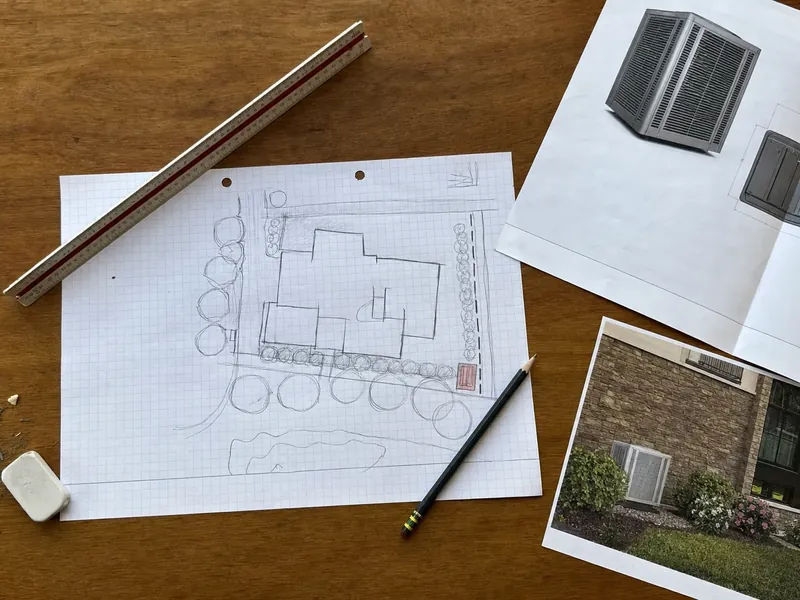
Requirements evolve, so confirm current process with the property owners' association directly. In practice, submissions of this type generally need:
- The proposed location of the outdoor unit, with a site sketch showing its relationship to property lines and neighbouring lots.
- Screening details — typically landscape or a constructed screen consistent with community standards.
- Equipment dimensions and, on some submissions, sound data.
- Contractor details and evidence of insurance.
Gate access and contractor logistics
Every trade vehicle needs authorisation, and unfamiliar contractors lose time to this on the first morning of every job:
- Contractor access is arranged in advance through the property owners' association, not at the gate.
- Commercial vehicle hours may be restricted, which shortens the working day and can turn a two-day install into three.
- Deliveries — equipment, and later the propane supplier's tank collection — need their own authorisation.
- Interior roads are steep, narrow and switchbacked. Larger delivery vehicles need routing planned, and in winter conditions some addresses are simply not reachable by a loaded truck.
That last point is worth dwelling on, because it is the same constraint that makes propane delivery unreliable here in the first place — see winter delivery reliability.
Want this run against your own delivery ticket and EMC bill? It takes one call. Free, no obligation.
Call (470) 208-3151Elevation and siting: why two Big Canoe houses need different systems
The property spans a wide elevation band and a wide range of exposures, and both matter to the load calculation:
- Ridge and upper-slope lots
- Highest design-temperature penalty and heavy wind-driven infiltration. Large view glazing is common and oriented for the view rather than for solar gain. Highest exposure to lightning-induced transients — see surge protection.
- Cove and lower-slope lots
- More sheltered from wind but subject to cold-air drainage pooling on still nights, which can put actual overnight temperature well below the nearest official reading.
- Lake-adjacent lots
- Added humidity load, and terrace levels that run damp year-round — often better served by a dedicated ductless zone than by extending the main system.
This is why we will not quote tonnage from an address and a square footage. Two identical floor plans a quarter mile apart on this property can carry meaningfully different loads.
The second-home problem, and why it favours conversion
A large share of Big Canoe homes sit empty for weeks at a time in winter, and that changes the risk calculation entirely.
An unoccupied house on propane has a failure mode with no one present to notice it: the tank runs low, the truck cannot climb the drive, the heat stops, and the first person through the door finds split supply lines. Electric heat removes the fuel-logistics dependency altogether — there is nothing to run out of.
For absentee owners we generally recommend pairing the conversion with remote temperature monitoring and, where the budget allows, standby power. The generator is not really about comfort on a property you are not occupying — it is freeze protection.
Run your own numbers
Delivered-BTU math, not a marketing estimate. Change any input and the result updates.
Example only: a house burning 850 gallons at $3.20/gal through an 80% furnace, against electricity at $0.13/kWh. Backup strip heat in a hard cold snap is not modeled. Enter your own numbers above.
- Delivered heat needed
- 62.2 million BTU
- Propane cost per delivered MMBTU
- $43.71
- Heat pump cost per delivered MMBTU
- $15.29
- Electricity used
- 7,320 kWh
- This winter on propane
- $2,720
- This winter on a heat pump
- $952
Worked example at typical North Georgia prices. Change any input above and this recalculates for your house. Estimate only, not a guarantee.
Free and no obligation. You are connected to one independent, licensed, insured Georgia contractor serving your area — never a call center, never a list.
Common questions about Big Canoe
Do I need architectural approval to replace HVAC equipment?
Can you get equipment to a steep switchback lot?
Is my house too high in elevation for a heat pump?
Where these numbers come from
- NOAA U.S. Climate Normals — station data behind the 13-18°F design temperature range
- NEEP Cold Climate Air Source Heat Pump Product List — capacity actually retained at 5°F, by model
Every contractor in this network holds a current Georgia Conditioned Air or Electrical Contractor license. You can confirm any license yourself before you sign anything — Georgia Secretary of State license lookup.
Get a conversion figure for your address
A contractor who works inside the gate regularly will know what the review submission needs before you start filling it in.
Free and no obligation. You are connected to one independent, licensed, insured Georgia contractor serving your area — never a call center, never a list.
More in Mountain Enclaves We Serve
Gate logistics, architectural review, slope staging, and microclimate load differences by community.