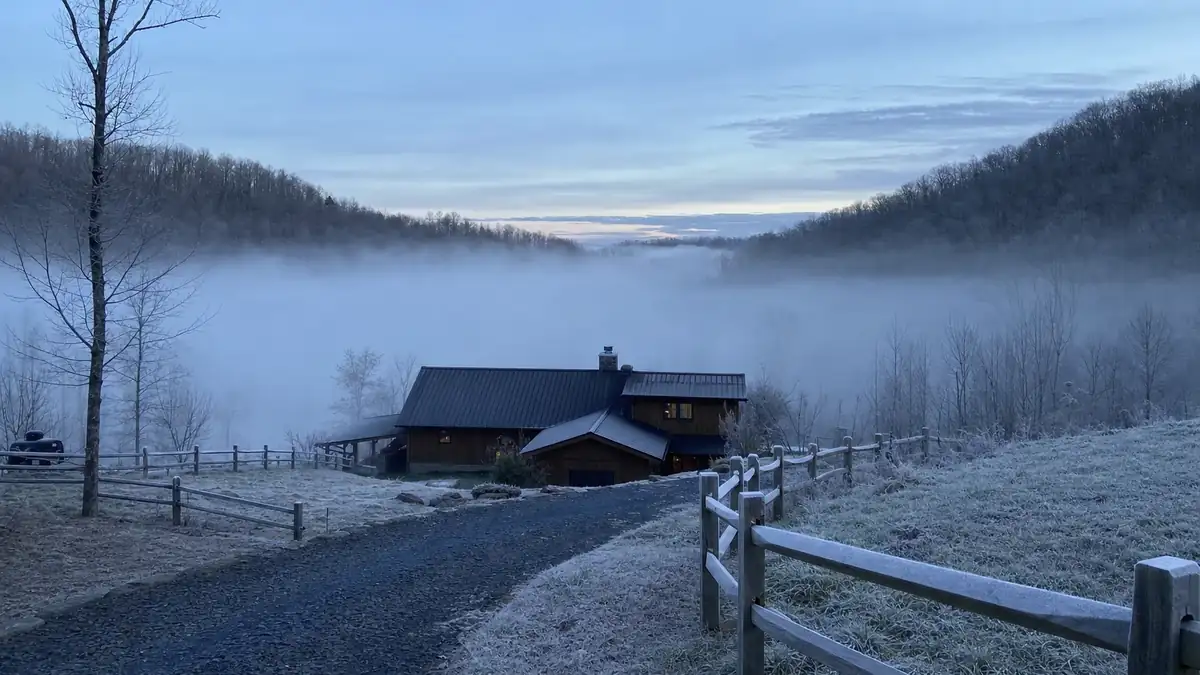
Marble Hill sits in terrain defined by hollows, where cold air drains downhill on clear still nights and pools. Overnight temperatures can run several degrees below the nearest official reading, so a load calculation using a generic regional design temperature undersizes equipment for the coldest nights. Damp hollows also increase defrost frequency.
Cold-air drainage, and why it defeats a generic load calculation
On clear, still winter nights, air in contact with the ground cools, becomes denser, and flows downhill. It pools in hollows, valley floors and drainages, and it can stay there until the sun clears the ridge.
The consequence is that a house sited in a hollow can experience overnight temperatures several degrees below the nearest official reading, and sometimes below a ridge-top house a few hundred feet higher. Frost forms there first and lifts last.
A load calculation performed against a generic regional design temperature misses this entirely, and the resulting equipment is quietly undersized for the coldest nights of the year — which is precisely when it matters. See load sizing.
What we look at on a Marble Hill site visit
- Position within the drainage. Valley floor, mid-slope or bench, and whether cold air has anywhere to flow past the house or pools against it.
- Obstructions downhill. A dense treeline, an embankment, a road cut or a neighbouring structure below the house can dam cold air on the property.
- Solar exposure. East-facing hollow sites can lose morning sun to a ridge and stay in shade for hours after sunrise, extending the coldest period of the day.
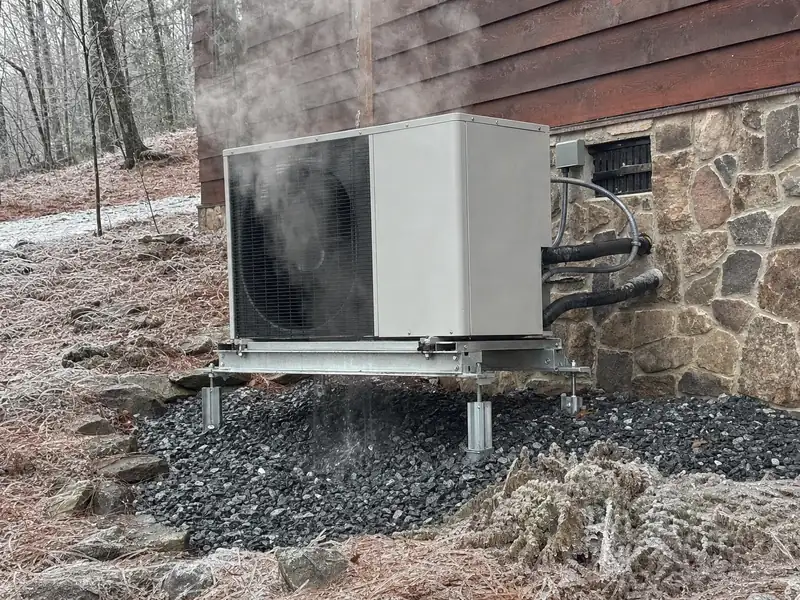
- Outdoor unit siting. Placing the condenser in the coldest, dampest pocket on the lot is a real and avoidable mistake. It increases defrost frequency and reduces available capacity at the worst moment.
- Drainage and standing moisture. Hollows collect water as well as cold air. The unit needs to sit above whatever the ground does in a wet February.
Want this run against your own delivery ticket and EMC bill? It takes one call. Free, no obligation.
Call (470) 208-3151Defrost behavior matters more in a damp hollow
Frost accumulates on the outdoor coil when it operates below freezing in humid air, and every heat pump reverses periodically to melt it off. Hollow sites are both colder and damper than the surrounding terrain, so they produce more frost and more defrost cycles.
Two specification points follow directly. First, demand-initiated defrost — which senses actual coil conditions — substantially outperforms simple timed defrost in these conditions, because timed defrost either runs cycles that are not needed or misses ones that are. Second, the unit needs to be raised sufficiently and drained properly, because meltwater that refreezes around the base pan on a lot that never gets full sun becomes a block of ice by mid-January.
Equipment selection for this microclimate
The combination of a lower effective design temperature and higher frost loading argues for the same conclusion the rest of this county reaches, with more urgency:
- Cold-climate inverter equipment with published capacity at 5°F, not a standard single-stage unit. See equipment selection.
- Design temperature established for the site, not taken from a regional table.
- Demand-initiated defrost, and outdoor unit siting out of the coldest pocket where the lot allows a choice.
- Elevated mounting with positive drainage away from the base.
- Balance point verified against the site design temperature, and the strip bank sized to the resulting shortfall rather than to the whole load.
Run your own numbers
Delivered-BTU math, not a marketing estimate. Change any input and the result updates.
Example only: a house burning 850 gallons at $3.20/gal through an 80% furnace, against electricity at $0.13/kWh. Backup strip heat in a hard cold snap is not modeled. Enter your own numbers above.
- Delivered heat needed
- 62.2 million BTU
- Propane cost per delivered MMBTU
- $43.71
- Heat pump cost per delivered MMBTU
- $15.29
- Electricity used
- 7,320 kWh
- This winter on propane
- $2,720
- This winter on a heat pump
- $952
Worked example at typical North Georgia prices. Change any input above and this recalculates for your house. Estimate only, not a guarantee.
Free and no obligation. You are connected to one independent, licensed, insured Georgia contractor serving your area — never a call center, never a list.
Common questions about Marble Hill
Why is my house colder than the forecast for Jasper?
Does this mean I need a bigger system?
Where should the outdoor unit go on a hollow lot?
Where these numbers come from
- NOAA U.S. Climate Normals — station data behind the 13-18°F design temperature range
- NEEP Cold Climate Air Source Heat Pump Product List — capacity actually retained at 5°F, by model
Every contractor in this network holds a current Georgia Conditioned Air or Electrical Contractor license. You can confirm any license yourself before you sign anything — Georgia Secretary of State license lookup.
Get a conversion figure for your address
If your thermometer regularly reads lower than the Jasper forecast, tell us. It changes the design temperature the system should be sized to.
Free and no obligation. You are connected to one independent, licensed, insured Georgia contractor serving your area — never a call center, never a list.
More in Mountain Enclaves We Serve
Gate logistics, architectural review, slope staging, and microclimate load differences by community.
Cluster hubBig Canoe →