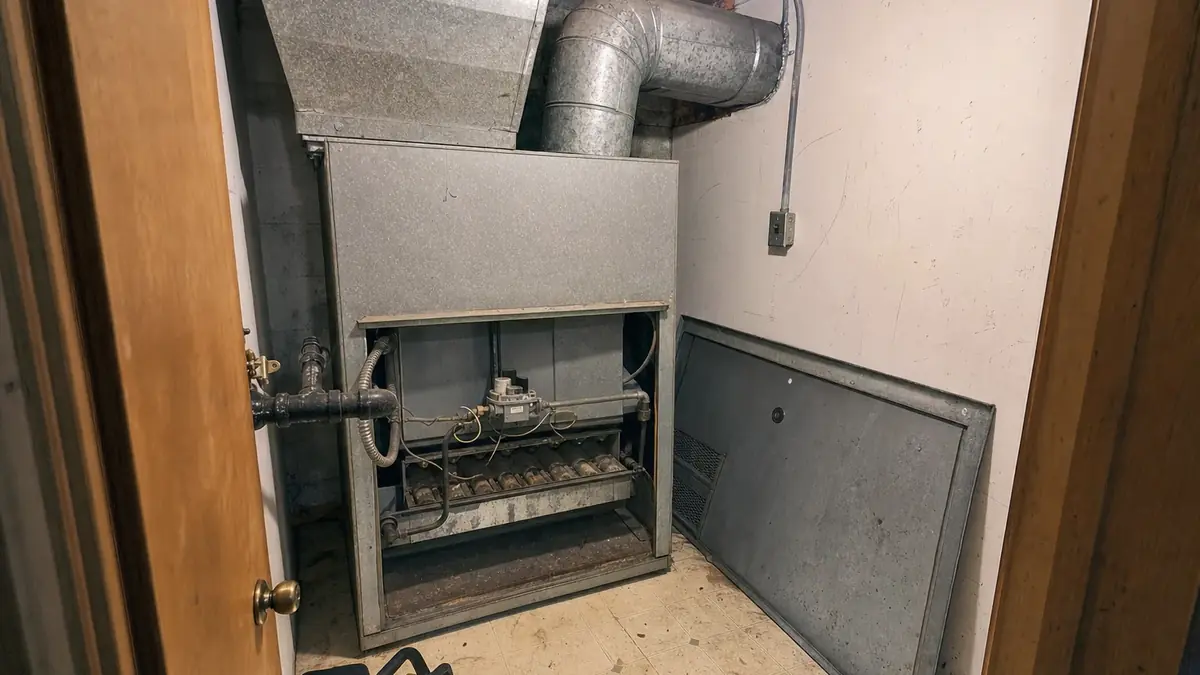
Short cycling — a furnace firing briefly then shutting off repeatedly — is almost always oversizing, not a thermostat fault. Two to three cycles per hour with meaningful run time is normal; six or more short bursts is not. A room-by-room Manual J load calculation using site design temperature and wind exposure is what sizes replacement equipment correctly.
Why oversizing is the default in this market
Oversizing happens for reasons that are commercially rational and technically wrong:
- Rule-of-thumb sizing. A BTU-per-square-foot figure carried over from another climate and another era of construction.
- Like-for-like replacement. The new unit matches the old one's tonnage, which propagates a forty-year-old sizing error forward another twenty.
- Defensive sizing. An oversized furnace never produces a callback saying the house is cold. An undersized one does. The incentive runs one direction.
- Ignoring envelope improvements. New windows, added attic insulation or air sealing since the original install all reduce the load, and nobody recalculates.
What oversizing actually costs you
| Symptom | Mechanism |
|---|---|
| Uneven temperatures | Cycles end before air fully distributes to distant rooms. |
| Drafts and cold spots | High-output short bursts instead of long, gentle circulation. |
| Higher fuel consumption | Every ignition cycle has a purge and warm-up loss; more cycles, more loss. |
| Shortened equipment life | Ignition and start-up are the highest-wear moments in the cycle. |
| Poor humidity control (cooling) | The coil never runs long enough to dehumidify. |
| Noise | Full-output starts rather than steady low-level operation. |
Manual J, and what makes it different in the mountains
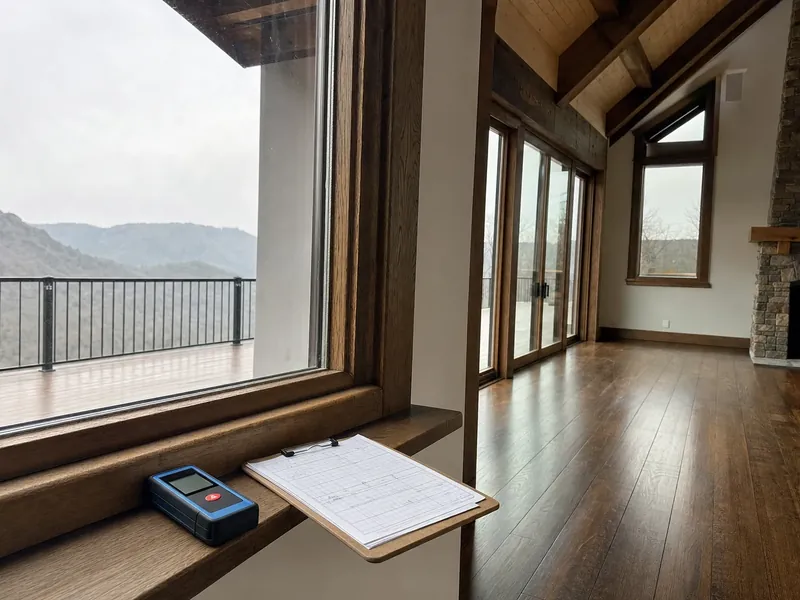
A Manual J load calculation is a room-by-room heat loss and gain assessment. It measures the building rather than estimating from floor area, and for a Pickens County house it must account for inputs a generic calculation skips:
- Design temperature adjusted for elevation. The difference between 1,500 feet in Jasper and 2,800 feet on a Big Canoe ridge is real and is not a rounding error.
- Wind exposure. Ridge-top and saddle sites carry far higher infiltration than the same plan in a hollow.
- Cold-air drainage. Valley and hollow sites pool cold air on still nights, producing overnight temperatures well below the nearest official reading.
- Actual orientation and glazing. Mountain homes are often sited for the view, which means large glass areas facing whichever way the view faces — not whichever way is thermally sensible.
- Walk-out and below-grade surfaces. Ground-coupled surfaces behave nothing like above-grade walls.
Want this run against your own delivery ticket and EMC bill? It takes one call. Free, no obligation.
Call (470) 208-3151Why this matters more for a heat pump than it did for the furnace
An oversized propane furnace is wasteful. An oversized heat pump is worse, because sizing interacts directly with the balance point and with the inverter's ability to modulate.
Undersize it and you spend the winter on supplemental heat, which destroys the operating-cost case that justified the conversion. Oversize it and the compressor runs at the bottom of its modulation range, cycles, and loses the long steady runtimes that make inverter equipment comfortable and efficient in the first place.
The load calculation is not paperwork. It is the design.
Run your own numbers
Delivered-BTU math, not a marketing estimate. Change any input and the result updates.
Example only: a house burning 850 gallons at $3.20/gal through an 80% furnace, against electricity at $0.13/kWh. Backup strip heat in a hard cold snap is not modeled. Enter your own numbers above.
- Delivered heat needed
- 62.2 million BTU
- Propane cost per delivered MMBTU
- $43.71
- Heat pump cost per delivered MMBTU
- $15.29
- Electricity used
- 7,320 kWh
- This winter on propane
- $2,720
- This winter on a heat pump
- $952
Worked example at typical North Georgia prices. Change any input above and this recalculates for your house. Estimate only, not a guarantee.
Free and no obligation. You are connected to one independent, licensed, insured Georgia contractor serving your area — never a call center, never a list.
Common questions about short cycling & Manual J sizing
How many cycles per hour is normal?
Can you fix short cycling without replacing the furnace?
Do you charge for the load calculation?
Where these numbers come from
- AHRI Directory of Certified Product Performance — verify any quoted HSPF2, SEER2 and capacity rating
- NOAA U.S. Climate Normals — station data behind the 13-18°F design temperature range
Every contractor in this network holds a current Georgia Conditioned Air or Electrical Contractor license. You can confirm any license yourself before you sign anything — Georgia Secretary of State license lookup.
Get a conversion figure for your address
Ask to see the Manual J inputs, not just the recommended tonnage. We will walk you through ours line by line.
Free and no obligation. You are connected to one independent, licensed, insured Georgia contractor serving your area — never a call center, never a list.
More in Equipment & Mountain Engineering
Capacity retention at design temp, hybrid architectures, and load sizing for homes above 1,800 feet.
Cluster hubCold-climate inverter heat pumps →