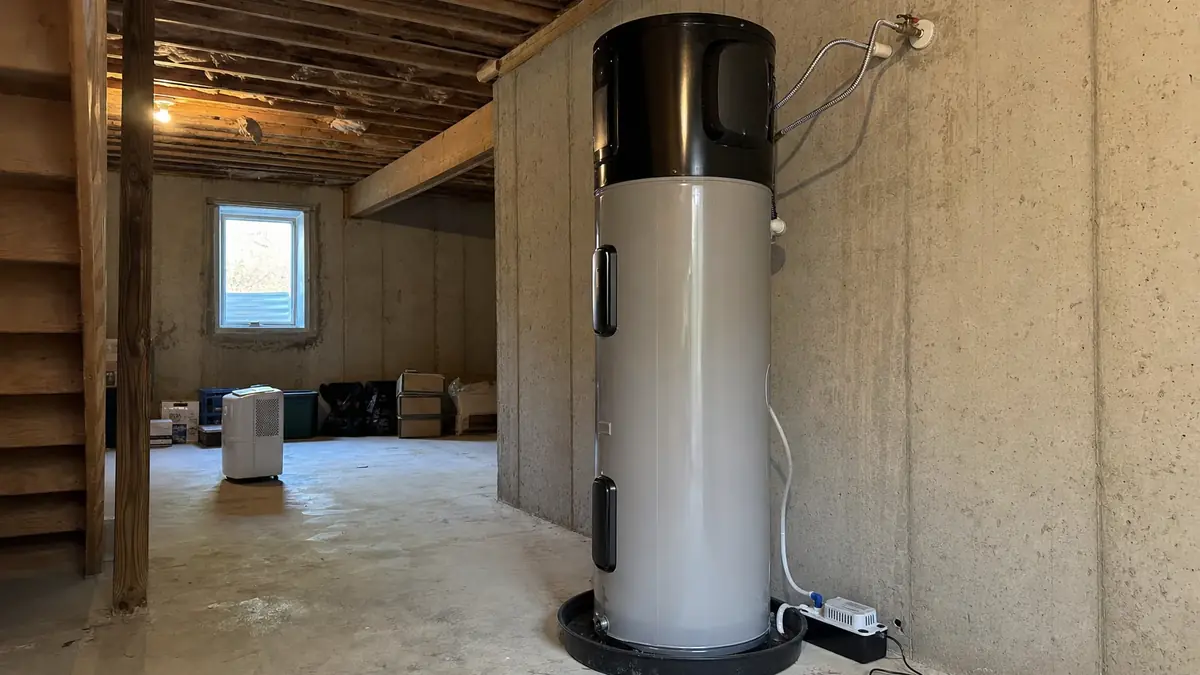
A hybrid heat pump water heater moves heat from surrounding air into the tank instead of burning propane, running roughly three to four times as efficiently as resistance elements. It needs about 700 cubic feet of unrestricted air, an ambient temperature above roughly 40-45°F, and a condensate drain. Recovery is slower than propane, so size the tank up a step.
What a hybrid water heater actually is
A heat pump water heater is a storage tank with a small heat pump on top. It pulls heat out of the surrounding air and puts it into the water, which is dramatically more efficient than making heat — typically in the region of three to four times the efficiency of a resistance element.
Every model also carries conventional resistance elements as backup, which is what makes it a hybrid. Operating modes generally include an efficiency mode using the heat pump only, a hybrid mode that brings elements in under heavy draw, and a high-demand mode for houseguests.
The two requirements that decide whether your house is a candidate
- Air volume
- The appliance needs a meaningful volume of air to draw heat from — commonly around 700 cubic feet of unrestricted space, though the manufacturer's figure governs. A tight mechanical closet does not qualify unless it is ducted or louvered.
- Ambient temperature
- Heat pump mode requires the surrounding air to stay within an operating range, typically somewhere around 40–45°F at the low end. An unheated crawlspace in a Pickens January may fall outside it, at which point the unit reverts to resistance elements and the efficiency advantage disappears.
- Condensate drainage
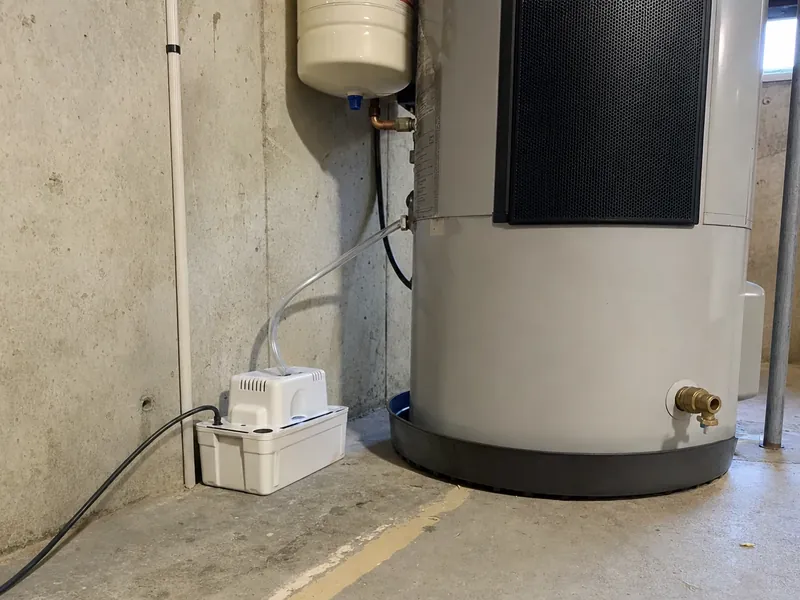
- It produces condensate like an air conditioner and needs a drain or a pump.
- Physical height
- Taller than the propane tank-type unit it replaces. Measure before ordering, particularly in a low basement.
The side effect nobody mentions, and how to use it
A heat pump water heater cools and dehumidifies the space it sits in. It is taking heat out of that air, after all.
In a conditioned basement in winter that is a genuine drawback — you are pulling heat from air you paid to heat. In a Pickens County terrace level in summer it is close to a free dehumidifier, which in this climate and this housing stock is worth having.
Placement therefore matters more than for the appliance it replaces. An unconditioned garage or a large open unfinished basement is usually ideal; a small conditioned utility room is usually not.
Want this run against your own delivery ticket and EMC bill? It takes one call. Free, no obligation.
Call (470) 208-3151Recovery rate: the expectation to set correctly
In heat pump mode, recovery is slower than a propane water heater. This is the one genuine functional trade-off and it should be discussed before purchase rather than discovered afterwards.
The practical mitigations are straightforward: size the tank up a step relative to what you have now, since storage compensates for recovery; use hybrid mode when the house is full; and use the scheduling function, which pairs well with time-of-use rates if your co-op offers them.
For a two-person household, efficiency mode on a correctly sized tank is generally unnoticeable. For a full house on a holiday weekend, hybrid mode exists precisely for that.
Run your own numbers
Delivered-BTU math, not a marketing estimate. Change any input and the result updates.
Example only: a house burning 850 gallons at $3.20/gal through an 80% furnace, against electricity at $0.13/kWh. Backup strip heat in a hard cold snap is not modeled. Enter your own numbers above.
- Delivered heat needed
- 62.2 million BTU
- Propane cost per delivered MMBTU
- $43.71
- Heat pump cost per delivered MMBTU
- $15.29
- Electricity used
- 7,320 kWh
- This winter on propane
- $2,720
- This winter on a heat pump
- $952
Worked example at typical North Georgia prices. Change any input above and this recalculates for your house. Estimate only, not a guarantee.
Free and no obligation. You are connected to one independent, licensed, insured Georgia contractor serving your area — never a call center, never a list.
Common questions about heat pump water heaters
Is it worth converting the water heater if I am not converting the furnace?
Will it make my basement cold?
How noisy is it?
Where these numbers come from
- ENERGY STAR heat pump water heaters — current federal efficiency thresholds
- U.S. Energy Information Administration — energy conversion calculators — heat content of a gallon of propane
Every contractor in this network holds a current Georgia Conditioned Air or Electrical Contractor license. You can confirm any license yourself before you sign anything — Georgia Secretary of State license lookup.
Get a conversion figure for your address
If we are already quoting a furnace conversion, ask us to price the water heater in the same visit. The labour overlaps.
Free and no obligation. You are connected to one independent, licensed, insured Georgia contractor serving your area — never a call center, never a list.
More in Equipment & Mountain Engineering
Capacity retention at design temp, hybrid architectures, and load sizing for homes above 1,800 feet.
Cluster hubCold-climate inverter heat pumps →