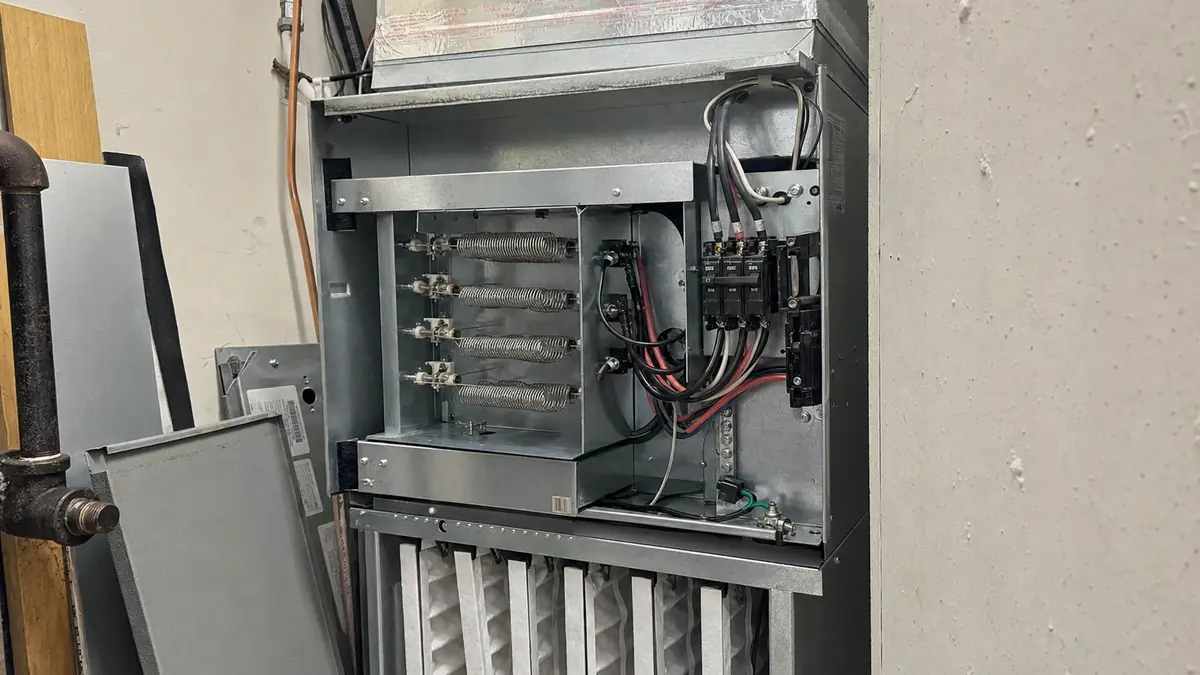
Electric strip heat is sized to the shortfall between heat pump capacity at design temperature and the house's heat loss, not to the whole heating load. Banks come in 5, 10, 15 and 20 kW, drawing roughly 21, 42, 63 and 83 amps at 240 volts, treated as continuous load at 125% for conductor and breaker sizing.
How strip heat is circuited
Strip heaters are resistance elements installed in the air handler, typically supplied in banks of 5, 10, 15 or 20 kW. Each bank draws substantial current at 240 volts, and the code requirements follow directly:
- Fed by two-pole breakers, because the load is 240V.
- Treated as a continuous load, so overcurrent protection and conductors are sized at 125% of the calculated current.
- Frequently split across multiple circuits — manufacturers commonly limit a single circuit to 48 amps, so larger banks arrive as multiple sub-circuits with individual protection.
- Conductors sized to the ampacity required after the continuous-load factor, with correction for ambient temperature where the run passes through a hot attic.
- Terminated at the air handler's factory-supplied breaker kit where one is provided — field-fabricated arrangements are a common inspection failure.
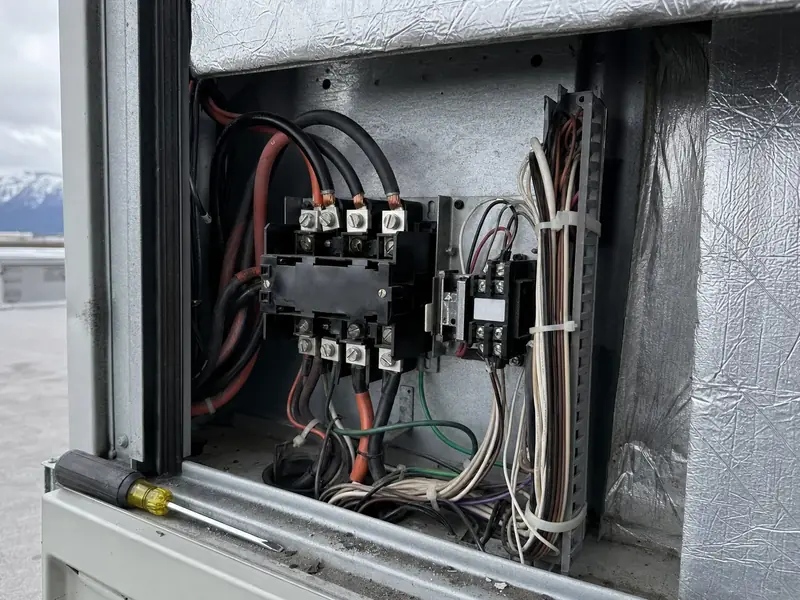
Sizing: less is usually the correct answer
Strip heat should be sized to the shortfall between the heat pump's delivered capacity at design temperature and the house's calculated heat loss — not to the whole heating load, which is how it is habitually specified.
The default of fitting the largest bank the air handler accepts is defensive rather than engineered, and it costs twice: once in the electrical scope required to feed it, and again every winter it runs instead of the heat pump.
| Approach | Consequence |
|---|---|
| Sized to full heating load | Largest bank, most circuits, service upgrade near-certain, highest winter operating cost. |
| Sized to calculated shortfall at design temp | Smaller bank, often fewer circuits, service upgrade frequently avoided, strips engage rarely. |
| Dual-fuel — no strips at all | Propane furnace is the backup stage. Largest load removed from the calculation entirely. See dual-fuel. |
Want this run against your own delivery ticket and EMC bill? It takes one call. Free, no obligation.
Call (470) 208-3151Sequencers, lockouts and staging
Strip heat should never simply switch on with the compressor. Correct control is what keeps it from dominating your winter bill:
- Sequencers bring elements on in stages with a delay between them, limiting inrush and avoiding all-or-nothing operation.
- Outdoor lockout prevents the strips engaging above a set outdoor temperature, so they cannot run on a mild day because the thermostat was nudged up.
- Staged supplemental control allows the thermostat to call for only the elements needed rather than the full bank.
- Defrost-only operation uses a minimal element during defrost cycles to temper supply air, without engaging the full bank.
A system where the thermostat's 'Emergency Heat' setting bypasses the compressor entirely should be understood by the homeowner as a failure mode, not a comfort setting. It runs the house entirely on resistance heat at a COP of 1.0, and left on by accident for a month it produces the electricity bill that makes people distrust heat pumps.
What to verify at commissioning
- Breaker sizes match the nameplate and the installed elements, not the air handler's maximum rating.
- Conductor sizes match the breakers, with derating applied for attic or high-ambient routing.
- Outdoor lockout is configured to a temperature that reflects your actual balance point — not left at a factory default.
- Staging operates: verify each stage engages independently.
- The homeowner has been shown what 'Emergency Heat' does and when to use it, which is essentially only when the compressor has failed.
Run your own numbers
Delivered-BTU math, not a marketing estimate. Change any input and the result updates.
Example only: a house burning 850 gallons at $3.20/gal through an 80% furnace, against electricity at $0.13/kWh. Backup strip heat in a hard cold snap is not modeled. Enter your own numbers above.
- Delivered heat needed
- 62.2 million BTU
- Propane cost per delivered MMBTU
- $43.71
- Heat pump cost per delivered MMBTU
- $15.29
- Electricity used
- 7,320 kWh
- This winter on propane
- $2,720
- This winter on a heat pump
- $952
Worked example at typical North Georgia prices. Change any input above and this recalculates for your house. Estimate only, not a guarantee.
Free and no obligation. You are connected to one independent, licensed, insured Georgia contractor serving your area — never a call center, never a list.
Common questions about strip heat circuits & breakers
How much strip heat do I need?
Why is my electric bill enormous when emergency heat is on?
Can I add strip heat later if I need it?
Where these numbers come from
- NFPA 70, National Electrical Code — service capacity, load calculation and surge protection requirements
Every contractor in this network holds a current Georgia Conditioned Air or Electrical Contractor license. You can confirm any license yourself before you sign anything — Georgia Secretary of State license lookup.
Get a conversion figure for your address
Ask what balance point our proposal produces and what strip bank follows from it. Those two numbers set your electrical cost.
Free and no obligation. You are connected to one independent, licensed, insured Georgia contractor serving your area — never a call center, never a list.
More in Electrical Infrastructure & Backup Power
Service capacity, strip-heat circuits, generator compatibility, and surge survival on rural EMC lines.
Cluster hub200A service & load calculation →